We've moved!
DakotaFreePress.com!

Social Icons

twitterfacebooklinkedinrss feed
Showing posts with label bicycles. Show all posts

Thursday, August 22, 2013

Lake County to Extend Bike Trail, Save Trees!

The Lake County Commission went on the road Tuesday to "research" (I giggle just a little) their bike trail extension plans. Real research would have included riding their bikes out to Lake Madison.

Connecting the current spur of the bike trail that ends at the U.S. Fish and Wildlife Service entrance (hey! FWS! Close that facility before you close the Booth Hatchery!) to the county's public access area on the southwest shore of Lake Madison. To get there, the county needs to lay about one and a quarter miles of new trail south along Highway 19, then east parallel to 236th Street, along the south edge of the remaining county poor farm land. That eastward stretch has a shelterbelt on it. The commissioners and highway superintendent Scott Mathison had the good gosh-darn sense to suggest that the county save the trees:
Once on site, the commissioners and Lake County Highway Superintendent Scott Mathison seemed to feel the north side of the trees was best. They seemed to agree that putting the trail along the road or going through the shelterbelt would likely require taking out several trees, which would be an expensive proposition.

Mathison seemed confident that the trail would work on the north side by taking out the volunteer bushes and trimming up trees. The commissioners did not take any formal vote on the matter [Jane Utecht, "County Takes Research Road Trip," Madison Daily Leader, 2013.08.21].
Yay for trees! Madison's bike trail currently runs through mostly open country. After a mile or two of leaning into the sun and stiff south wind, all pedalers will enjoy that quarter mile of shade and shelter. Keep those trees!

The county could save a little concrete by continuing the southeasterly diagonal of the first part of this trail extension right on through the Sunset Harbor development right to the public access area beach. Residents there would enjoy quick and easy bicycle access, and cyclists from town could get to the beach faster with less time spent alongside the noisy highway. Developer Dan Lemme might be interested in such a trail proposal. He met with commissioners on their road trip at Sunset Harbor and proposed that the county swap him some of its poor-farm land for the squiggly, woodsy strip of land he owns on the south shore of Herkimer Pond. Utecht's text is fuzzy here, but she reports that Lemme suggested continuing the bike path through that area for beach access. Perhaps Lemme would also support the mountain-bike loops that Tony and I think would be a great idea!

Connecting the current Madison bike path to the county's beach is a good idea. But remember: if you really want bicycle bliss, you've got to build a loop. I have my plan for a loop around Lake Herman; our county commissioners should think big and extend their current trail in a long figure out around Lake Madison and Brant Lake down to Chester and back!

Friday, September 3, 2010

Funniest Bike Part I've Bought

After ten years of serious bum friction, I decide it's time to buy a new bike seat. I order another split seat, designed to preserve proper sensation and function in the old kibble and bits (the old split saddle did a fine job of keeping my parts... sensational). Planet Bike calls their seat the "Anatomical Relief Saddle." Cool. Fine.

Then I catch the abbreviation. This is what I now sit on while pedaling:
Cory's new bike saddle

Clever devils.

Thursday, August 26, 2010

Green Notes: Bikes, Solar, Good Sense Challenged

Buried in browser tabs! Time to clear the queue!

Colorado is seeing a weird outbreak of velophobia. Some folks have a Sibby-Ellis-tinged idea that promoting Denver as a bicycle city is part of the United Nations' sinister agenda to enslave us all. The tiny casino town of Black Hawk, Colorado has banned bicycles: a new Colorado law requires motorists to give bicycles at least three feet when passing, and Black Hawk reasons that complying with that law would be just too hard for the big tour buses bringing gamblers to town. Riding your bike through town now gets you a $68 fine (to make up for cyclists not spending as much on booze, I guess).

Green power is ugly. Or so goes the thinking, apparently, in Hanover Township, Northampton County, Pennsylvania. Township supervisors there have imposed restrictions on solar panels: tucking panels away beside or behind the house is fine, but if you happen to have a south-facing abode and want to place your panel out front where it will do the most good, you need to get a conditional permit, which will take $800, two months, and all sorts of paperwork. Says a state township association official, "A lot of people have a problem with placing solar panels on the front of their homes for the simple reason...solar panels are distracting and take away from the value of [their] house.... Elected officials are hearing that and they're taking that into consideration." Once again, obsession with appearance trumps environmental sense and property rights.

Solar power is making progress in California. Regulators there have approved the first solar thermal plant in the U.S. in two decades. Ah, good old American innovation... maybe we'll catch up with Portugal after all.

But not if boneheads like Don Kopp stay in office. One of South Dakota's most embarassing legislators provides a teabaggers' splinter group in Rapid City with a slideshow assortment of decontextualized quotes—prooftexting at its finest (and a popular pastime among the non-thinkers in the Tea "Party"). The slides flog the U.N.-evil meme and insisting environmentalists are out to lynch America (yes, slide #10 includes a noose). I'm sure Kopp et al. consider this Kansas City artist's work on sustainable buildings an effort to destroy America, too.
------------------------------
But think positive: Lester R. Brown sees renewable energy booming worldwide and thinks we can "replace all coal- and oil-fired electricity generation with renewable sources." There is life after oil and coal, people. The sooner we get serious about making it happen, the easier it will be... unless of course you think living like Mad Max would be cool.

Thursday, August 12, 2010

Lost and Found: License Plate SD 1YH883

Cory's recumbent, with found license plateDon't play chicken with a blogger on a recumbent. ;-)
Someone in Minnehaha County is looking at his bare bumper and saying, "I thought I wired that sucker on there tight!"

The Madville Times goes on bike patrol in central Lake County, sweats off five pounds before the thunderstorm comes, and finds a bonus treasure on Highway 34, just west of Pizza Ranch: one expired South Dakota license plate! SD 1YH 883, expiration date November 2009, newly liberated thanks to some rusty 12gauge wire that just wasn't up to the job.

If this plate is near and dear to your heart, give me a shout. I might have an envelope big enough to return your treasure.

Thursday, July 22, 2010

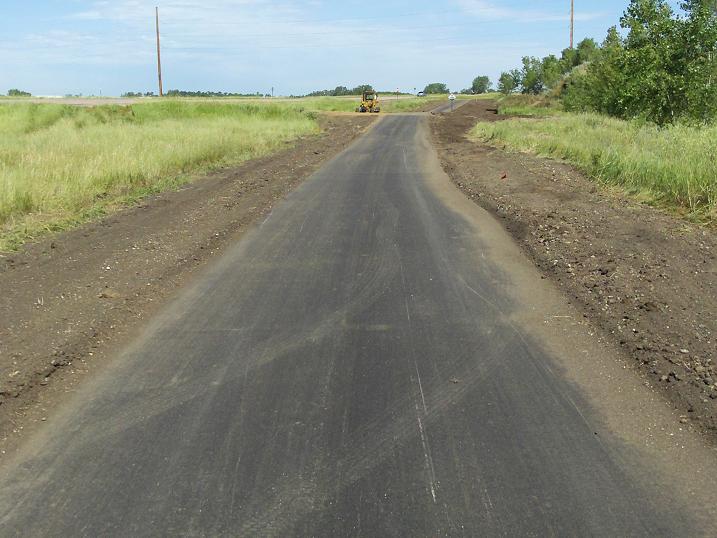
New Bike Trail Spur Paved Along Highway 19

Is that new pavement I see? Let's ride!

USFW bike trailhead, Highway 19, Lake Madison, SDCrews have finished laying the pavement for the new bike trail spur that connects the main Madison–Johnson's Point trail with the U.S. Fish and Wildlife Office on Highway 19. Paving included a nice little parking spot at the USFW headquarters entrance... because heaven knows nothing will fly in Madison without lots and lots of parking. (You can see all the parking I needed up by the wetlands kiosk.)

small grove of trees along bike trail, Highway 19, Lake Madison,  SDYay for trees! This shady copse greets riders at the south trailhead.

bike trail from saddleAh, fresh asphalt. Zoom!

soft shoulder on bike trailYeah, soft shoulder. Not to worry—I'm sure the sity will send out our man Ted LaFleur and the rake crew with some grass and wildflower seed, and we'll be pedaling past prairie pasque presently.

up the hill!
Up the hill toward the Highway 19–34 intersection—Most of this spur, like the main trail, is out in the open. Perhaps the Lake Madison Sanitary District will do riders a favor and plant some trees alongside the west edge of their containment ponds. After all, do visitors really need a clear view of our admittedly glorious sewage treatment facilities?

bike trail at Highways 34 and 19, east of Madison, SDView south from the trail intersection—The ride from USFW HQ to the 19–34 intersection is just 0.7 miles, but it's a nice addition to the 4.2 miles that parallels 34 from town out to Lake Madison. Next priorities: extending this spur all the way down to the public access area and the mondo-cool mountain bike park we could build on the old gravel pit, then giving riders an actual loop! Riders love loops!

Monday, July 19, 2010

Boost Rural Entrepreneurship: Build Bike Trails?

...and support small firms!

As the Madison City Commission prepares to make its case to the public for building a bike trail to Lake Herman, the commissioners might want to keep a copy of this blog post on outdoor amenities in their back pockets. Mike Knutson at Reimagine Rural summarizes a USDA/U. Tennessee study on "The Rural Growth Trifecta: Outdoor Amenities, Creative Class and Entrepreneurial Context." Say Knutson and the professors:
  1. More people are looking to move out of urban areas (in other words, there are more fish coming! Cast your line, rural economic developers!)
  2. Rural towns with outdoor amenities draw more creative folks, see more entrepreneurial action, and generate more jobs.
  3. Rural towns lacking outdoor amenities tend to draw more folks who fill factory jobs but fewer folks who create new jobs.
So if I take this summary correctly, building more bike trails could support building more jobs. (I'm telling you, build the Lake Herman Loop, and we'll be in high cotton!)

Of course, manmade features like recreation trails would only make up a tiny portion of outdoor amenities. The study measures outdoor amenities by the following characteristics:
  • January sunshine
  • January temperature
  • July humidity
  • July temperature
  • topographic variation (hills! vistas!)
  • water area (Lake Herman!)
  • mix of forest and open space (plant more trees... but not too many! the optimal forestation amount on this scale appears to be between 41% and 64%)
  • tourism (visitors and residents are attracted by similar features)
Alas, put all those things together, and we prairie folks have our work cut out for us. This map from page 10 of the study shows we South Dakotans sit right in the middle of the least outdoor-amenitous area of the nation:

Source: David McGranahan, Timothy Wojan and Dayton Lambert, “The rural growth trifecta: outdoor amenities, creative class and entrepreneurial context,” Journal of Economic Geography Advanced Access, May 17, 2010.

Uff da. With everywhere but the Black Hills and the Badlands falling into the bottom quarter of the outdoor amenity scale, most of South Dakota has a hard row to hoe in selling itself to the migratory creative class. I would suggest that we need to make the most of what watery, woody, hilly places we have. In other words, run some trails out to the Vermillion Hills, keep Lake Madison as clean and accessible as possible, and for Pete's sake, don't chop down those shelterbelts!

Also worth noting in the study:
  1. The third and fourth sentences: "Traditional strategies of promoting exogenous growth through the recruitment of employers are now much less effective. Routine and lowskill functions are increasingly outsourced to low-wage countries." As LAIC director Dwaine Chapel comes asking the city commission tonight (and county commission tomorrow) for our tax dollars, perhaps someone ought to discuss a shift from the failing strategy of recruiting those big outside employers.
  2. The lit review notes that folks in small firms tend to move into self-employment more often than folks in large firms. Now there is some self-selection involved—entrepreneurial types gravitate toward small firms in the first place. But recruit and/or seed 40 little firms that employ ten people each, and you lay the groundwork for more independent entrepreneurship than if you recruit one big firm that employs 400 people. (This sounds so familiar!)

Friday, July 2, 2010

Madville Times "Lake to Shining Lake" Bicycle Ride Saturday 8 A.M.!

This time we thought we'd plan ahead....

Blog and bike enthusiasts alike, up for a bike ride tomorrow morning? Regular commenter, avid cyclist, and MHS debate alum Tony Amert is in town for America's birthday and suggested we ride our mountain bikes from Lake Herman to Lake Madison and back, as we both did most separately a couple July 4ths ago. Then we thought, heck, why not invite everyone else?

The plan:
  • Meet at the public access boat ramp on the west side of Lake Herman at 8 a.m. Saturday, July 3, 2010. That's on Cottonwood Cove Trail, within view of my green house.
  • Recommended gear: fat tires (we're riding lots of gravel) and water
  • Estimated distance: about 22 miles from lake to lake (longer if we get lured by detours)
  • Planned route: see map! We'll go south around Lake Herman first, through the boonies to Lake Madison, and up to the new public access area. From there, we'll wend out way back toward Madison and Lake Herman.
  • Possible detours: east on the paved bike path to Johnson's point; charge through downtown; loop through Lake Herman State Park and Dirks Resort.
Come climb some gravel hills (slight bumps, my Black Hills friends will call them) and anoint yourselves in the cooling waters of Lake County's crystal blue-green gems. Come ride!

Saturday, June 5, 2010

New Public Access Open at Lake Madison

...and other reasons for a ride in the country...

Some people think signs like this are signs of progress:
Sunset Harbor housing development sign
But when you go to the lake, would you rather see this:
'Private Property: No Trespassing' sign
Or this:
Public Access sign
That happy blue sign is your welcome to the newest public access area on Lake Madison. After considerable public discussion last year, Lake County has opened its shoreline property to the public for fishing and recreation. The entrance is on 236th Street, not quite a half-mile east of Highway 19.

tree with lock and chain
Where a chain gate hung two weeks ago, the driveway is now open. But don't steal that tree.

Through the shelterbelt, you're greeted by this view:
view of new county public access area on Lake Madison
Long driveway, wide beach, and a nice view of the western lobe of Lake Madison. The county commission also appears to have taken heed of local folks' obsession with parking. There's room for five times as many cars and trucks as there is for fishermen sitting cheek to cheek on the beach.

dock at Lake Madison public access area
Your tax dollars at work: there's a nice dock on floats, just waiting for fishermen on the beach. There's no boat ramp here, so docile fisherfolk won't need to move over every few minutes for folks launching and beaching.

On my Friday afternoon visit, there were a couple of ladies reclining on the beach and flattering their swimsuits. Courtesy forbade my snapping their pix, so instead...

modern outhouses
...outhouses. Folks around here are almost as obsessed with potty as with parking. The county and A-1 Portable Toilets have us covered, with Men's and Women's. (The bikini ladies are just around the men's station.)

inside modern outhouses
Ah, so clean, so commodious....

new spruce trees planted on east side of Lake Madison public access area
Check out the new trees! Just as pretty as Commissioner Bert Verhey painted them. Some of the McMansioneers on Woodland Drive had concerns about allowing the common folk access to the neighboring county land. The county thus planted some really nice spruces all along the eastern fence. Now the neighbors won't be disturbed by the view of those fisherman... or bikini ladies... or the county gravel pit.

trees along east side of Lake Madison public access area
Alongside the spruces toward the shore, there's also a really big water pump and hose at water's edge. If the fishermen get too rowdy, I assume the sheriff can come out, fire up the pump, and powerwash miscreants right off the beach. Cool.

county gravel pit
farm equipment on county land at Lake Madison
That reminds me: the new public access area adjoins the county gravel pit, not to mention the hundred-some acres of the rest of the old poor farm that the county rents out for crops. There goes the county mingling recreation and industry. Didn't the commission consult with David Pitts, who said the two don't mix?

But I gaze eagerly into that gravel pit and see an opportunity. Just think what a great mountain bike park we could build here.

truck tracks near shore in gravel pit west of Lake Madison public access areaThere are already a number of truck tracks around the county gravel pit area. Add on to them. Haul out the remaining easy-to-get gravel for public use, then bring in Rapid City bike trail expert Tony Amert to supervise grading out some fun and swoopy adventure trails.

gravel pit, no trespassingCome on, sheriff—let me in!

The coming extension of the Madison bike trail south along Highway 19 makes turning the poor farm into a bike farm a natural next step. But let's not stop there. Let's think really big.

Lake Madison public access area... possible amphitheater?The grounds south of the beach include a big basin that looks an awful lot like an amphitheater. Bring a couple bands and a few hundred picnic blankets, and you have a lakeside music festival! Lake Madison Development Association, discuss.

Historical Marker for Old Madison, Highway 19The new public access area is near the site of Old Madison, the first county seat. The county seat moved when certain city fathers swiped the county safe from the Lake Madison site and hauled it in the dark of night to "New" Madison, the present county seat. (Ah, our fair city, established on a foundation of theft and secrets. Again, discuss.)

Extending the bike trail out to the public access area opens itself to another festival event: we could re-enact the great county safe heist! Bring out a bunch of replica safes, load them on trailers, and challenge cyclists to hitch up and race back to town lugging a few hundred pounds of steel and county papers. First one to the courthouse wins a DQ Blizzard and a rubdown!

shelter belt near Lake Madison public accessAnd how about some shady picnic space? That shelterbelt along the county road looks pretty healthy. Run one spur of the bike trail through the shade along the north edge of the trees, mow some clearings, place some picnic tables... presto! Another step toward the fabled Bicentennial/Semiquincentennial Park that fisherpeople, bicyclists, and swimsuit-clad picnickers could all enjoy!

Oh, about those swimsuits. Who needs those curves, when just up the road I could find some curves I can really get into:

curvy gravel road through USFW refugeFellow mountain-bikionados riding out to the new public access area might enjoy this alternate route back to town. A half mile north from the Highway 19-County Road 236 intersection lies one of those welcome prairie rarities: an honest-to-goodness curvy road! The gravel road snakes west through the U.S. Fish and Wildlife refuge. Not quite the thrill and excitement you can find on two wheels out in the Black Hills, but still a quiet, scenic country ride away from highway traffic.
No Target Shooting sign, USFW landPlus, you probably won't get shot.

Lake County has made a wise investment in creating the new public access area on the southwest shore of Lake Madison. It provides another welcome recreation opportunity for residents and visitors alike. It also opens the door to new recreational endeavors that would draw more people to enjoy our fair square of the prairie.

--------------------------
Bonus video! A very mellow view of my ride along the USFW road. Sorry, no wipe-outs, just gravel and grass, water and wind, birds and a bunny... all in pixellated Impressionism. ;-)

Monday, May 24, 2010

Madison Names Price for Bike Trail Land Acquisition

On the agenda for tonight's Madison City Commission meeting: discussion of the how much the city will pay landowners for allowing construction of the Lake Herman Recreation Trail on their land.

You have page through nineteen liquor license applications to get to it, but on page 45 of the agenda packet, you can find out how much the city plans to offer David Pitts and other landowners for the privilege of taking the right of way permanently out of their use.

If I'm understanding what's written in the city's "acquisition formulas," each landowner gets $500 up front. Then the city goes to Shirley Ebsen's office at the courthouse, gets the highest per-acre assessed value of the land in question, and multiplies by 2.

For temporary easements (the land the city will need to run the equipment up and down along the construction route), the city multiplies that land value by 20%. The city will add another 10% for crop damage.

For permanent easements, the city multiplies the land value by 140%.

Now I haven't taken the tape measure out to David Pitts's land, but I'm guessing the rec trail would slice about three acres off the east edge of his land. Let's wild-guess the value at $3000 an acre. By the above formula, the permanent easement for that strip of land would be the following:
  • $3000 x 2 x 1.4 x 3 = $25,200.
What do you say, David (and fellow farmers): is that price enough to seal the deal?

And if it isn't, is the city willing to go higher? Is this bike trail worth paying the price the market will demand? And if not, will the city risk the political fallout of eminent domain?

A bike trail would be nice. It would draw tourists and boost economic development. But as I heard a wiser financial head than myself say this week, the bike trail is a want, not a need. The city tonight will make clear the price it wants to pay. If David Pitts doesn't want to accept that price, then so be it. Eminent domain should not follow.

By the way, I went for a couple of bike rides this weekend. Both days I rode the county road that parallels most of the proposed bike route, 234th Street, from Lake Herman State Park to Madison, just as I have for 21 years. Nice smooth road, traffic generally light and polite. Sure, I'd enjoy another path, but I can get where I want to go now just fine with the existing infrastructure. Of course, if the county would like to widen the shoulders, I wouldn't complain. David Pitts might not, either.

Tuesday, April 27, 2010

City Postpones Hiring Lawyer for Bike Trail Eminent Domain

Two phrases I do not like to see in the same article: eminent domain and recreation trail. Those phrases were on the Madison City Commission agenda last night. The city was to consider authorizing a contract with Jencks & Jencks, P.C., to handle "legal and eminent domain actions" in acquiring the land necessary for the proposed Lake Herman bike trail. The contract approved up to $30,000 for the legal work (with the possibility of amendment upward), with hourly pay for the lawyers at $80.

But that item didn't stay on the agenda. At the beginning of the meeting, City Engineer Chad Comes asked for its removal.

The agenda change probably means little, probably just some more paperwork needs to be done before offering a contract to the law firm.

But if the city is even thinking of using eminent domain for the bike trail, they have a long row to hoe before getting the public (or me) on board.

Monday, March 29, 2010

Lake Herman 60 Degrees, 70% Ice-Free

...and I go for a bike ride....

Whoo-hoo! Lake Herman is open... mostly! 60° Fahrenheit, big bright sun, and 20–30-mile-per-hour south wind have pounded the local ice cap apart (click pix to embiggen!):


The view from the porch: lake wide open toward the north! The white on the far shore is the ice heaved up by the wind onto the rocks.

Looking east toward the state park, we see some ice still hung up along our shore in "Cottonwood Cove."
South side of the lake still socked in. Tomorrow's seventies and more south wind ought to fix that.

Of course, what's a beautiful day like today without a bike ride! I stopped by Lake Herman Auto, where my neighbor Dan Uthe has had a 2008 Smart fortwo on display this month. dan didn't pay me to stop by to do an ad; I just wanted to compare the Smart to my favored mode of transportation:

The Smart is a little longer than my Burley, although if I were riding in long-wheelbase mode, it would be close. It cost me $900 to get my Burley six summers ago; Dan's asking $13,998 for the Smart. On dollars per inch, I think I got the better deal.

But if my bike had a car rack, I'd have bungeed that Smart to the back of my bike and brought it home.

Sunday, February 28, 2010

Brookings Bike Path to Serve Business, Commuting

My trip to judge debate in Brookings this weekend reminded me that our progressive neighbor to the northeast is expanding its bike trail this year. The city commission awarded local contractor Rounds Construction $608K of work extending the city bike path under I-29 to the Swiftel Center and business park on the eastern edge of Brookings.

Brookings has a nice recreational bike trail crossing the south half of town. This new extension serves business as much as pleasure. A bike trail isn't just a luxury: it can be a way for people to get to work. Ask Kevin Brady: even on cold days, biking workers are happy workers!

Right now, the only way to pedal to the Swiftel Center or Daktronics is to brave the multi-lane madness of Sixth Street past Wal-Mart and across the I-29 overpass, perhaps the least bike-friendly pavement in Brookings. Providing a dedicated bike route under the Interstate will make traveling safer for cyclists and drivers alike.

Discussing Madison's proposed bike trail extension to Lake Herman, landowner David Pitts has argued industry and recreation shouldn't mix. Brookings's bike plans suggest otherwise. Brookings is laying bike paths to the doorstep of its convention center and big industrial employers. Brookings recognizes that a bike path is essential infrastructure just like a street.

* * *
Madison should connect with Brookings's more progressive thinking. Heck, maybe Madison should just connect with Brookings! Imagine if we made a deal with Brookings to lay a bike trail kittywampus from Brookings down to the Brookings Country Club, around Lake Campbell, slant to Nunda or Rutland (preference, anyone?), and right on to Main Street Madison. Maybe we could even make a big triangle with Dell Rapids. A nice prairie loop like that could be a bike tourist's dream!

Wednesday, February 17, 2010

Time to Reflect: Bike-Passing Bill Gets Complicated

Michael Christensen of the Minus Car Project alerts us that SB 70 is bouncing toward an unpleasant amendment today. The bill would require motorists move over at least three feet to pass cyclists. (never mind that that's impossible on Madison's new tight five-laner.)

Minus Car reports that primary sponsor Senator Sandy Jerstad plans to introduce an amendment today requiring cyclists to wear reflective clothing. If I'm reading the language right, it won't be enough to have reflectors on the bicycle; you'll hae to wear shiny stuff as well.

Now I already have enough fancy bike clothes and reflecto-straps and winky-blinky lights to make me look like flying saucer cruising Lake Herman at night (at 18 miles an hour... not quite advanced alien technology). This amendment wouldn't keep me off my two wheels.

What worries me is that this amendment would criminalize casual bicycle use for 99% of the potential pedaling population. I want to promote bicycle use in South Dakota. I want people to be able to just hop on their bikes and ride the few blocks down to the park or the grocery store to run everyday errands. A sure way to stifle growth in bicycle use is to say to those casual riders that, before they hop on the pedals, they have to put on special clothes.

The way to promote bicycle riding in South Dakota is not to make life harder for cyclists. The way to promote bicycle riding is to enforce the existing pecking order—pedestrians get right-of-way first, then non-motorized vehicles, then motorized vehicles, everywhere. We also need to train drivers to watch the heck out.

Cyclists are on a 30-pound machine. Motorists are piloting a couple thousand pounds with 130 times the momentum. The more damage you can do, the more responsibility you have. Watch for bikes. Move over. And for pete's sake, don't make it any more expensive for folks to get out of their cars and travel under their own power.

----------------------
Update 2010.02.18 15:15 CST: Mike McDowell and the State Senate roll with me on this one. SB 70 and amendments go down a floor vote.

Monday, December 21, 2009

Lake Herman Solid for Ice Shacks and Bikes!

Who needs a bike trail to Lake Herman...

photo: rear wheel, mountain bike, on Lake Hermanhow I got home today

...when there's a bike trail on Lake Herman!!!

Cory smiling after bike ride across Lake Herman, winter solstice 2009No breakthroughs, no broken bones... sure I'm smiling!

The ice shacks are out on Lake Herman. I rounded the south shore, then pedaled straight across from the state park to the western shore. No big heaves, no mushy spots... but remember, that was 150 pounds of guy and layers on 30 pounds of bicycle. If you really want to haul your two tons of pickup truck out on ten inches of ice, that's your business.

trees under heavy frost along southeast shore of Lake Herman, near state parkLake Herman State Park, southeast shore

See more photos from my solstice ride on Lake Herman @ Flickr. Happy Solstice, pagans and believers of all flavors!

Friday, December 11, 2009

80 Bicycles Power One House

The BBC puts 80 cyclists to the test huffing-and-puffing to generate enough electricity to keep up with an electric water heater. Watch this video (dang! no embed!)... and watch out for the naked guy!

1 house, 80 cyclists... o.k., so maybe bicycle power isn't a viable option for all of our home electricity needs. Of course, we could always try slavery, like they did in good old Athens... though for that many drachmas, a wind turbine and solar panel shingles are probably still a better deal.

Tuesday, December 1, 2009

Rapid City Hansen-Larsen Park: Best Biking in America?

I know some folks think a good bicycle transportation network is just a luxury. But good bike trails can make for some darn good press for your town. Look at the attention Rapid City is getting for its newest bike trails, the Hansen-Larsen Memorial Park. One magazine calls the new trail system the best bike park in the country. The National Park and Rec. Assoc. named the Black Hills Fat Tire Festival held there the "best commercial recreation and tourism special event" of 2009. (Yeah, that's a mouthful, but if I were the Chamber of Commerce, I'd take best in the nation in anything anytime).

Says Rapid City parks and Rec director Jerry Cole:

There isn't anything within Rapid City like this. There isn't anything within 99 percent of the cities in the United States like this. This is unique....

This has the potential to change Rapid City for the betterment of the community and the visitors that will come here [quoted by Emilie Rusch, "New Park Drawing National Praise," Rapid City Journal, 2009.11.30].

But also note, City of Madison, this amazing trail system was built with zero tax dollars and no eminent domain. All it took was a community, including some smart donors, who recognize the cultural and economic value of good recreational infrastructure.

Wednesday, November 4, 2009

Your Opinion: Eminent Domain for Madison Bike Trail No Go

Madville Times readers are apparently passionate defenders of property rights. Our latest poll asked "Do you support using eminent domain to extend Madison's recreational trail to Lake Herman?" The results:
  • Yes: 21 (27%)
  • No: 56 (73%)
If I were a Madison City Commissioner, I might well say, "That's that" for eminent domain on the bike trail. After all, if anyone is going to draw the sort of hippie socialist crowd that would favor seizing private property for the collective pedaling good, it's this blog. Yet even readers here appear to be saying a bike trail is not worth violating private property rights.

I'm still open to the argument that the social benefits of a bike trail outweigh private property rights in this case. But the city and trail supporters will have to work really hard to make that argument. In the meantime, let's offer all the landowners a more-than-fair price for the privilege of using their land. Let's give them ironclad assurances that state law protects them from liability (and that if state law doesn't, the city and county will).

And if the landowners turn down our offer, then we'll have to be content to find an alternative route.

Saturday, October 31, 2009

SD Law Limits Bike Trail Liability?

One of the arguments I've heard against building the Lake Herman bike trail is liability. Private landowners don't want to be sued by individuals who might tumble off their bikes on their land or wander off the trail and trip on a corn stalk or who-knows-what. I think I've even heard some folks fret about the liability the county might incur if the trail is alongside the road.

I'm still waiting for someone to provide an example of case law where an adjoining landowner gets sued by a cyclist for an accident on a bike path. We are certainly a litigious society, so I would think if there's a legal leg to stand on, someone would have already filed such a case.

But I'm thinking you won't find such an example in South Dakota, because statute appears to protect landowners and public officials from such liability. Check out South Dakota Codified Law Chapter 20-9, Liability for Torts. Specifically, see SDCL 20-9-12 through 20-9-22. SDCL 20-9-13 appears to absolve farmers like David Pitts of any obligation to maintain safe conditions around a bike trail through their land or even to warn trail users of hazards on the land. SDCL 20-9-21 appears to protect local government from liability for accidents on land local government might invite folks to use for recreation. Certainly landowners and public officials still have some obligations, but so do users of recreational land.

As far as I can tell, state law has just the protections I was looking for for landowners next to the bike trail. If I go for a ride and take a tumble, it's pretty much my own darn fault.

Blog Brings Neighborly Conversation: David Pitts Sets Record Straight

One of the greatest merits of blogging is that it gets me into conversations that might never otherwise happen... often with people who vigorously disagree with me. Sometimes that conversation happens online, sometimes off.

Sometimes it's a two-and-a-half-hour conversation with a fellow Lake County resident whose language I have called "selfish, inconsistent, and at least unneighborly if not insulting."

David Pitts called Thursday evening.

From the top: Mr. Pitts called to ensure that at least two issues were straightened out:
  1. Contrary to the characterization I gave in my original article on the bike trail the city wants to build across the land he farms on the southwest edge of Madison, David Pitts and his wife Gloria do not live in or by Ramona. They lived up in that neck of the woods for a long time, and Mrs. Pitts was postmaster in Ramona, but a year or so ago, they moved into Madison. David Pitts is a taxpaying resident of the city that wants a piece of his farm land.
  2. Mr. Pitts also felt I dismissed his arguments against the bike trail and said he should have just said no. (I believe he may be referencing this passage from my Oct. 22 post: "I have deep sympathy for arguments in defense of personal property. If Mr. Pitts wishes to simply say, "It's my land, and I don't want to sell," that's fine.") Mr. Pitts emphasized that he had already told the powers that be "No" to this project five times—six, if you count the open house we both attended last week.
Mr. Pitts and I have lived in the same county for my whole life. He's my dad's age; his son Gary graduated from Madison HS a year before I did. It took this long for the two of us to end up in the same room last week, two feet apart over the same maps. But even there, David and I didn't talk. He had more important people at whom to direct his questions and concerns than a strange skinny guy with a backpack. I went to the meeting to listen, not argue. I checked my rebuttive urges until I had slept on what I'd heard a couple nights. Then I published a pretty stern critique that I knew wouldn't go down well with some readers.

Mr. Pitts said he was pretty steamed when a copy of the text reached him. When the phone rang and he introduced himself, I was ready for steam and checking my own valves. But we never got hot with each other. For two and a half hours, we had a perfectly neighborly and serious conversation about property rights, farming, bike trails, and local government.

Mr. Pitts and I still disagree on the value of a bike trail. I've given my reasons; let me give Mr. Pitts's view some air time so we all—including some of the folks who are more committed to building this bike trail than I am—can better understand where he's coming from.

Mr. Pitts has lived in this county all his life, just like me. His great-grandfather homesteaded here back in 1880, beating my forebears to this turf by a good 60+ years. He says he wants to see the land he has in this county remain in the family. He has at least as much reason for attachment to his patches of Lake County as I have to mine.

Mr. Pitts has honest concerns about the mingling of recreation and industrial agriculture. He sustains his land and productivity with heavy equipment and big chemicals. The big sprayer drivers and the crop dusters are as stingy as they can be with those expensive chemicals, but there will always be some drift. Right now, Mr. Pitts sees the fenceline, ditch, and raised roadway as a reasonable buffer to harm to passersby. Invite them onto the other side of that ditch on a ribbon of asphalt, and Mr. Pitts says his effective operating area will be reduced much more than the width of the trail and a flat strip of grass next to it.

(I did suggest going organic; Mr. Pitts said it would take too long to cycle the land into alternative production methods and turn a profit again.)

I haven't seen case law to justify Mr. Pitts's concerns about his liability for injuries on a trail crossing his land (and I'm reading up on SDCL 20-9 to see if it applies). But Mr. Pitts's concerns are reinforced by a grim experience on his land 22 years ago. His son went hunting with a couple other boys. Those other boys were walking the creek bed, one on each side, while Mr. Pitts's son waited at the end of the creek. A pheasant flew between the two walkers. One boy turned, shot from the hip.

There were 110 pellets in the shell that boy fired. The doctor took 97 pellets out of the other boy.

Mr. Pitts's liability insurance paid for the boy's medical bills. He was thankful worse didn't happen. But his insurer told him that, if he had charged a fee for the use of his land, his liability would have been much greater. So now, when the city asks him to accept payment for a recreational trail on his land, he puts two and two together and gets a concern informed by grim experience about having to pay for others' accidents.

Now as a businessman, Mr. Pitts could probably find out what the additional cost of liability insurance might be to cover the additional use his land would experience with a bike trail on it. He could add that to an estimate of the bushels of corn or beans lost to a 3-6 acre strip of pavement and grass. He would then have a good picture of what the city would have to offer to make the trail easement worth his while.

But interestingly, the city and other organizers have not once made a formal offer. No officials have told Mr. Pitts what the city will be willing to pay for the privilege of laying a trail on his land. In his dealings with the city, Mr. Pitts has gotten the distinct feeling that the city is more like a bully than a partner or the entity whose bills he pays with his taxes.

Cases in point: When the first proposal for a trail to Lake Herman started floating around a few years ago, Mr. Pitts says a trail organizer asked if they could sit down and discuss the plan over coffee. Mr. Pitts said he could do that some time... but he didn't hear anything else on the topic until a county commission meeting that considered applying for the grant to build the trail. Mr. Pitts says trail supporters considered circulating a petition seeking support to obtain land for the trail "by any means necessary" even before making any straightforward financial offers to landowners like him.

Mr. Pitts also notes that, as he understood it, the federal grant eventually obtained to trail up the neighborhood was designated for a trail along Highway 34. However (and this is all grapevine and no documentation, but I'm giving Mr. Pitts his say here), he heard that some of the bigger businesses along Highway 34 west of town didn't want the trail crossing their lots, and the city backed off that plan. So Mr. Pitts can't help getting the feeling that the city is just shopping around for little guys like him to push around.

His experience with the surveyors this spring didn't inspire any further confidence in our city leaders. With little warning, Mr. Pitts received a letter from Ulteig Engineering saying they would be coming onto his land to survey along the creek for a possible trail. Having just put in his wheat, Mr. Pitts was not eager to have surveyors tearing through his field on a four-wheeler. He called Ulteig, expressed his opposition, and apparently got them to call off the survey.

Soon afterward, however, he received another letter, this one from Madison's city attorney, Mr. Jencks, saying surveyors would be entering his land under statutory authority. Mr. Pitts couldn't remember the statute number in our conversation, but he says that when he showed his lawyer the letter, the lawyer looked up the law and found it dealt with abandoned mines and still required owner permission. Another phone call, another cancellation... but this time not before marking flags had been set in Mr. Pitts's field. Those flags are on wires. Leave one in the field, and it will run right through the combine and into the straw. Feed that straw to livestock, have a cow chaw down that wire, and that wire could kill the animal. Mr. Pitts thus spent some extra time in the field picking up flags to make sure what he sees as an unauthorized entry on his land didn't also result in the loss of a valuable critter.

Given what Mr. Pitts told me Thursday night, it's not hard to construct a narrative where, far from being the bad guy, Mr. Pitts is the average little guy, just trying to make a living and keep his land for himself and his kids while the powers that be—powers who wages he's paid for years with his sales tax and now property tax dollars—try to push him around.

So maybe we can understand a little better why Mr. Pitts might be inclined to offer some stiff resistance to a plan that could lead to the city taking his land. And in the face of such resistance, maybe we'll have to accept a compromise and live with widening the county road for a less-than-ideal but better-than-current bike route.

That's a discussion we as a community need to have. The best decisions will come from an open, above-board discussion where everyone, including David Pitts, gets a say.

Monday, October 26, 2009

A Bike Trail Is Not a Pipeline: Where I Don't Stand on Eminent Domain

Sibby cuts to to the heart of an issue that I've been grappling with myself on the proposed Lake Herman bike trail:

During the TransCanada pipeline issue, you took what I thought was a pro-property rights position. But now it is obvious that you are not for property rights. So your TransCanada position must have been based soley on your radical environmental ideological worldview [Steve Sibson, comment, Madville Times, 2009.10.25].

Steve isn't the only Sibson whom I expected to brand me as an ideological traitor, and I've been mighty nervous about that very prospect. I have been very vocal in my opposition to the use of eminent domain and my defense of personal property rights for everyone from the farmers and ranchers along the Keystone pipeline and DM&E rail routes to Madison's own Dick Wiedenman. Yet I have characterized farmer David Pitts's language in defense of his property rights against encroachment by a bike trail as "selfish, inconsistent, and at least unneighborly if not insulting."

Sibby and Jason Bjorklund both rightly ask, What gives?

Review the record: at no point have I said I support taking David Pitts's land or anyone else's by eminent domain for the proposed bike trail. I've said previously that I oppose using eminent domain to build a bike trail. When I heard folks talking about the prospect of resorting to eminent domain for this project, my heart sank.

But let's get clear on one thing: TransCanada's use of eminent domain to build the Keystone pipeline is very different from the potential use of eminent domain to build the bike trail to Lake Herman.
  1. The TransCanada land grab transferred land rights from various private parties to another private party. Eminent domain for this bike trail would transfer private land rights to the general public.
  2. TransCanada took land under the flimsy claim that its pipeline is a "common carrier," a notion I find laughable, since TransCanada is the only party making direct use of the pipeline. The Lake Herman bike trail would be open to use by all residents and visitors alike.
  3. TransCanada's Keystone pipeline provides no direct benefit to any landowner whose land has been taken for the pipeline easement or to any adjoining community. A much stronger case can be made that the bike trail provides direct benefits to the community: increased tourism, increased sales tax revenue, more recreational activities, and safer bike and pedestrain travel in town and to and from Lake Herman State Park (and I'm not even working hard to think up those advantages). Even the landowner stands to benefit—I will posit that direct access to a bike trail increases the sale value of the land for residential and commercial development. (Real estate agents, feel free to chime in with your perspective!)
It is also important to note that we aren't even at the eminent domain stage yet. David Pitts sure makes it sound like he won't sell, no way, no how... but his position may be nothing more than hardball negotiation to squeeze from the city every penny he can get. I have no problem with driving a hard bargain to get the best market price possible, and from the sounds of it, the city will likely offer a price significantly better than market value to make this project happen.

As I said to Jason, I don't stand to benefit much personally from the bike trail. The shortest route for me to ride to town will still be Highway 34... and contrary to Mr. Pitts's opinion that I have all the time in the world, when it's 0°F, I want my ride to be as quick as possible.

I don't need a bike trail. I don't need David Pitts's land to get to class or the park or anywhere else I ride.

However, I can look beyond myself. I can recognize that a lot of casual cyclists don't feel comfortable going pedal-to-gas-pedal with texting teen drivers and rumbling semis. I can recognize that plenty of campers feel a bit uneasy taking their kids on a bike ride to town on a county road with no shoulder. And I can recognize that bicycle tourists won't make an extra trip to Madison just ride on the shoulder of a highway.

I hope Mr. Pitts will look at both his self-interest and the public interest and realize that expanding the right-of-way easement on his land can serve both. He can make a guaranteed pot of money up front and still sell his land for development, quite possibly at a better price. He can also pave the way for increased recreational opportunities and tourism that will benefit everyone in the county. The Lake Herman bike trail is a win-win situation. We shouldn't need eminent domain to make it happen.

But if Mr. Pitts can't see that, if he fails to see how he himself comes out ahead on this deal, the city will have to make a very clear and evidenced case that the public benefits of the bike trail outweigh the personal property rights of Mr. Pitts and the other landowners along the proposed route. I await the making of that case.