We've moved!
DakotaFreePress.com!

Social Icons

twitterfacebooklinkedinrss feed
Showing posts with label Minnesota. Show all posts

Wednesday, December 22, 2010

Lange: SD Can Learn from Minn. Statesmanship, ND Criminal Justice

Last week I noted the difference in fiscal politics between Minnesota and South Dakota. That essay arose from a conversation with my neighbor and outgoing state legislator Gerry Lange. In the following guest column, he exapnds the view to include North Dakota:

Recent headlines here in Madison and in Minnesota highlight our two states’ sharply contrasting value systems. Here in South Dakota, our leaders are telling us we’ll have to cut ecucation funding to balance the budget! There in Minnesota, the finally-elected new governor, a multi-millionaire heir of the Dayton fortune, is acting like a statesman with “noblesse oblige!”

Rather than slashing education and vital services, he’s calling on his own class of affluent “winners” to come up with more income tax to patch their budget holes. How could sister states be so different? Could be a matter of their preferring a number one quality of life where it’s worth the trade-offs: more taxes for better wages, better infrastructure, and no taxes on food, clothing, auctions, and building contracts.

National government publications are rich with “best practices” from other states. As legislators, we brought home numerous “success stories” from meetings all over the country. One of the best that could save us millions is as close as North Dakota! They’ve been doing “electronic monitoring” and intensive probation for quite a few years. Results? 1000 fewer in prison than here, and a ten percent recividism compared with some fifty percent in most states.

Most of our leaders in Pierre know this, so it’s puzzling as to why we don’t adopt this successful approach. Do South Dakotans really believe that converting colleges to prisons has been a better strategy? Do tax-fearing voters really prefer to balance the budget on the backs of our kids?

—Gerald Lange, December 2010

Friday, December 17, 2010

Dairy Dozen Converts to Chapter 7; MPCA Nixes Dairy Permit Appeal

The Bernie Madoff of dairy feedlots, serial polluter Rick Millner, is having a very bad week. Millner's Veblen, South Dakota-based dairy management company the Dairy Dozen has been going through Chapter 11 bankruptcy. On Wednesday, U.S. Bankruptcy Court Judge Charles L. Nail, Jr., granted a trustee's motion to convert that bankruptcy from Chapter 11 to Chapter 7.

Chapter 11 is where you get a shot at reorganizing. Chapter 7 is where you throw in the towel and liquidate to pay off your creditors. As I read it, that means the Dairy Dozen is toast.

Then on Thursday, across the border in Minnesota, our friends at the Minnesota Pollution Control Agency officially said no flippin' way (o.k., I'm paraphrasing) to Millner's attempt to reopen his Excel Dairy in Thief River Falls. MPCA shut down that Millner monstrosity in 2009 and denied it a permit in April of this year for hundreds—hundreds—of air quality violations. Millner and fellow Dairy Dozen owners of Excel appealed. MPCA documented Millner's trail of environmental destruction at every dairy he's been involved with, took public comment, and yesterday said no more.

Grand Forks Herald reporter Kevin Bonham says no one answered his calls to the Dairy Dozen's Veblen office Thursday. Maybe they've already sold the phones.

It's a shame that the Dairy Dozen has done so much economic and environmental harm to so many communities. But perhaps South Dakotans and Minnesotans can breathe a little easier with these two big steps toward putting the dirty Dairy Dozen out of business for good.

Tuesday, December 14, 2010

Raising Taxes "Nuclear Option" in SD, Path to Governor's Mansion in MN

South Dakota faces a projected budget deficit of $74.8 million, about 6% of our projected FY2010 general fund expenditures. But asking South Dakotans to pay, say, a half-penny sales tax increase to cover our expenses is deemed "the nuclear option."

How does paying for the services we need become more unthinkable that cutting state aid to K-12 education 5%?

Maybe we could osmose some political courage by spending more time at the Mall of America. That thriving commercial establishment is in Minnesota, which faces deficits of $3 billion this year and next. That's 16% of Minnesota's state budget. How do they propose to close that fiscal gap?

Wealthy businessman Mark Dayton campaigned for governor on a platform of taxing himself and his rich compatriots more. He advocates creating a new income tax bracket for individuals making more than $130K and couples making $150K (yeah, that's rich around here). He advocates a new property tax bracket for homes worth over $1 million. He'd also tax predatory credit card companies.

Dayton would also make a whole whack of spending cuts, but he puts the tax increases at the top of the page, and additional revenue outpaces savings four to one, acknowledging, perhaps, that it's better to pay the piper for services citizens need than cut government services and inefficiently shift costs to local governments and individuals.

The Minnesota Chamber of Commerce finds such proposals abominable, but Dayton campaigned openly on these tax increases and won the governor's chair. Not by much, but he won.

Are Minnesota and South Dakota really that different? We were both settled by the same hardy, taciturn German and Scandinavian stock. We both deal with harsh winters and the disappointment of the Minnesota Vikings (or out in the Hills, the Broncos). How can we be so different in politics?

Governor-Elect Mark Dayton shows us that a prairie state doesn't have to fight deficits with one fiscal hand tied behind its back. Governor-Elect Dennis Daugaard should pay attention.

Sunday, November 21, 2010

Minnesota Seeks Denial of CAFO Permit for Habitual Polluter

The Minnesota Pollution Control Agency has 111 confined animal feeding operation (CAFO) permits pending. Over the next month, after the standard 30-day public comment period, MPCA intends to approve 110 of them. MPCA has announced its intent to deny reissuance of just one of those CAFO permits.

Who gets skunk eye from MPCA? The New Horizon Dairy LLP of Hoffman, Minnesota. MPCA has dealt with this dairy previously, fining New Horizon $17,400 in 2007 for over-application of manure and use of an unpermitted storage basin.

MPCA now looks at the record of New Horizon and the other dairies connected with its ownership and says they won't get fooled again. You see, New Horizon is another dairy managed by serial lawbreaker and polluter Richard Millner of Veblen, South Dakota.

Speculation: One might look at Millner's horrible, no-good, very bad month and conclude that the regulators, courts, and bankers are piling on. Perhaps they are. Millner has shown a willingness to hire lawyers and mount dogged if sometimes absurd

Say, the press loves a good bloodbath. It remains boggling to me that the South Dakota media have said nothing about the spectacular collapse of Millner's extensive dairy fiefdom. defenses to fend off legal challenges to his dirty business practices. Perhaps MPCA, DENR, AgStar, and everyone else to whom Millner has regularly flipped the litigious bird have been waiting for a moment when Millner's legal resources would be stretched to the limit. This year's bankruptcy proceedings appear to be doing that, and the regulators and others with skin in the game are moving in for a long-overdue kill.
Serial lawbreaker and polluter—that's not just blog hyperbole. That's the conclusion that MPCA supports with this summary of the persistent deception and CAFO permit violations committed at every major dairy Rick Millner has been involved with in the tri-state area. Let MPCA explain (with my occasional emphasis):

...In concurrence with its previous action in the Excel Dairy matter and in accordance with Minn. Stat. § 115.076, the MPCA has preliminarily determined that the applicant has a history of non-compliance with Minnesota rules, statues, and permit conditions. The applicant has a history of routinely modifying feedlot facilities without authorization from the MPCA, allowing discharges to waters of the state, violating the state ambient air quality standards, and noncompliance with permit and administrative order requirements. The MPCA is aware of the applicant’s involvement in seven dairy facilities, past and present, all of which have had various non-compliance issues....

New Horizon Dairy, Grant County, Minnesota:

...A subsequent July 28, 2005, site inspection revealed a discharge to a coulee was occurring during the land application of manure. The manure application rate was 20,000 gallons per acre and the same field had received 18,000 gallons per acre three weeks prior, resulting in over-application of manure nutrients.... Also during the inspection, it was observed that manure had been placed in an unpermitted manure storage structure at the facility as a means of storing excess manure....

Excel Dairy, Marshall County, Minnesota

...In January 2010, the Marshall County District Court issued an injunction against Excel Dairy because Excel Dairy had failed to remove the manure from its basin as its permit required. The injunction required Excel Dairy to remove the manure from the basin as soon as field conditions allowed in the spring of 2010. Excel Dairy has failed to comply with that injunction and has been held in contempt of court for that failure to comply with the injunction.

...When Excel Dairy applied for its 2007 permit, Excel Dairy submitted a narrative Air Emission Plan that stated that Excel Dairy would apply straw to the manure basins to establish and maintain a crust on the basins to control air emissions from the basins. When the MPCA called upon Excel Dairy to comply with the Air Emission Plan Excel Dairy had submitted, Excel Dairy indicated that it had submitted the plan “accidentally” and that it had never truly intended to crust its basins despite what the written plan stated.

...Excel Dairy represented to the MPCA that it would either house 1,104 mature dairy cattle over 1,000 pounds or house a hybrid cow that weighed less than 1,000 pounds so that the facility could stock a total of 1,545 cattle.... [Excel Dairy] instead chose to stock 1,545 cattle over 1,000 pounds at the facility. This would equate to 2,163 animal units, significantly more than allowed in any of the previous permits.

...Excel Dairy has violated Minnesota’s hydrogen sulfide standards hundreds of times since May 2008.... Excel Dairy’s violations have been so severe that the families that live near Excel Dairy have been rendered physically ill by the emissions and have been forced to flee their homes on numerous occasions because of the sickening emissions.

Unnamed Dairy, Roseau County, Minnesota

...Rick Millner operated this facility before abandoning it in 1997. In September 1997, the MPCA staff inspected the abandoned facility and observed manure stockpiles still remaining on site as well as two earthen manure storage structures that still contained manure and were not properly closed.

Lone Tree Dairy, Yellow Medicine County, Minnesota

...In August 2006, the MPCA staff inspected the facility and documented the basin manure level above the basin freeboard limit level and determined that unless immediate basin manure removal and land application occurred, the basin manure level was in danger of breaching the basin’s constructed berm. The MPCA staff also observed that loose soil had been dumped and spread on top of the southeast corner of the basin’s constructed berm in an apparent attempt to prevent basin manure from spilling out the basin’s southeast corner. The MPCA did not approve or issue a permit for this modification of the basin....

Five Star Dairy, Sargent County, North Dakota

In November 2006, the North Dakota Department of Health issued a notice of violation (NOV) to the facility and its managing partner Rick Millner. The NOV stated that Five Star Dairy failed to receive approval from the North Dakota Department of Health prior to constructing a new manure storage pond. Also, Five Star Dairy submitted records that indicated that the facility was stocked with more animals than its permitted capacity of 1,400 head prior to gaining the appropriate approvals....

...Five Star Dairy was once more inspected by the North Dakota Department of Health on October 27, 2009, and, during that inspection, it was observed that the manure storage basins did not have adequate freeboard remaining. Follow-up inspections on November 2 and November 10, 2009, found that the manure storage basins were still above the allowable operating level, and no manure had been removed. A November 19, 2009, site inspection did reveal that some manure had been removed, but the level of manure in the basins remained above the allowable operating level... [Minnesota Pollution Control Agency, Fact Sheet and Public Notice of Intent to Deny the Application for Reissuance of NPDES and SDS Permit for a CAFO Permit to New Horizon Dairy LLP, Hoffman, 2010.11.19]

MPCA also documents Millner's persistent violations of South Dakota environmental regulations and endangerment of the Whetstone Valley/Big Stone Lake watershed with his awful Veblen East and Veblen West dairies, as reported frequently here on the Madville Times.

Seven dairies. Seven dairies. Environmental violations at every one of them.

MPCA counts up the strikes and tells Rick Millner, "You're out!" It's about time. If a state issued a driver's license to a seven-time drunk driver, heads would roll. If a state issued a teaching certificate to a person convicted seven times of child neglect, heads would roll. That a serial offender like Millner has been able to stave off the law this long and pollute his communities for his own profit signals we need tougher enforcement of CAFO rules.

Monday, November 1, 2010

Regressive Tax Structure Not Correlated with Healthy Economy

Rep. Gerald Lange (D-8/Madison) has consistently advocated measures like repealing the sales tax on food and extending the bank and insurance income tax to corporate income in general to make South Dakota's tax structure more progressive. His opponents in the District 8 House race, Republican Patricia Stricherz and "Independent" Jason Bjorklund, have climbed all over each other to swear their opposition to income tax. Stricherz and Bjorklund both prefer a regressive tax system where they both as working-class folks pay 10% of their income in taxes while the rich people who control this state pay only 2% of their income in taxes.

Bjorklund and Stricherz have little reason other than electionering against Rep. Lange to oppose the income tax and other efforts to make our state's tax system more progressive. States like Minnesota with progressive tax systems are just as likely to enjoy healthy economic performance and business climate as state like South Dakota with regressive tax systems.

Think tank Minnesota 2020 studied the correlation between state tax structure and state economy in 2008. Minnesota 2020 ranked the states for tax progressivity, then ranked states on six different indices of economic well-being: economic performance, business vitality, development capacity, competitiveness, and two different measures of quality of life.

The results: comparing the progressivity rank with ranks with each economic index produces a slight positive correlation. In other words, states like Minnesota that move away from sales taxes and toward income taxes have a slightly better chance of having good business climates and quality of life than states like South Dakota that stick tax the poor harder than the rich. The correlation isn't much—the highest is a measly 0.20 on the economic performance index—but where it does show up, the correlation smiles on the tax system Gerry Lange proposes.

Now this doesn't mean you can't achieve relatively good economic results while laboring under a regressive tax system. South Dakota ranks 46th for progressivity in taxes, yet we come out in the top ten on three of the economic indices used in this study. We also rank 48th in business vitality, a measure of competitiveness and job growth from new businesses.

But you can also enjoy relatively good economic outcomes under a progressive system:

Why is this? One explanation is that states with the most progressive tax systems are better able to finance the educational and transportation infrastructure and the public services that a modern economy requires because they don't shift a disproportionate share of the burden of paying for these investments to households with the least ability to pay. The loss of high income households due to progressive taxation is offset by an increased ability to pay for public investments [Jeff Van Wychen, "Progressive Taxation: Not So Bad for Business After All," Minnesota 2020, 2008.01.21].

The evidence keeps building that Gerry Lange is right and South Dakota's tax system is wrong. Remember that at the polls tomorrow.

Tuesday, October 26, 2010

Clark Schmidtke's Side of the Story: "I'm Innocent!"

Permit me to update what I just published about the court records of our District 8 Senate candidates. District 8 Senate Candidate Clark C. Schmidtke Sr. and I just had a very serious conversation on the phone about his court records and what really happened in Minnesota. Trying hard to reserve judgment, I present what I've read and what I've heard (and delay once again talking about actual policies affecting District 8).

According to information from the Minnesota judicial system, in Case No. 46-K0-95-000504, The State of Minnesota vs. Clark Calvin Schmidtke, Judge Robert D. Walker presiding, our candidate was charged with 45 charges of theft and mistreatment of vulnerable adults.

Schmidtke says he was innocent. The county social worker, he says, brought bogus charges against him because the county owed his health care facility money and wanted to put him out of business. He did go out of business in 1995. He lived in Arizona at the time and thus had to fly back and forth for court appearances. He went to court 15 times. Eventually, Schmidtke says he ran out of money for the lawyer. He asked his lawyer how much it would cost to continue fighting the charges: $15,000. Schmidtke didn't have that money, so he switched to a public defender. That public defender recommended Schmidtke simply plead, take a few days' jail time and pay restitution. Schmidtke agreed and pled to three charges of theft. The remaining 42 charges we dropped... and Schmidtke spent eight months in jail and was assessed $14,225.96 in restitution.

The court record shows $580 credited toward restitution in 1997. Schmidtke's first payment is listed in 1999. Schmidtke then made 19 payments from 1999 to 2003 adding up to $6530. The Minnesota judicial website indicates that Schmidtke's current balance due is $7,695.96.

Schmidtke says that last figure is an error. In 2004, another complication arose. Schimdtke's probation officer claimed she didn't know Schmidtke had moved to South Dakota, hauled him back to Minnesota, and tossed him in jail. Schmidtke says his son then looked through his dad's phone records and found information that showed the probation officer would have known from those records that Schmidtke was in South Dakota.

If I understand the story, it was at this point that Martin County Attorney Terry W. Viesselman stepped in and said enough's enough. Schmidtke says Viesselman recommended the court reduce the case from felony to misdemeanor and drop the remaining restitution at this time. Schimdtke says the court did just that. He has not made any further restitution payments at this time, as it was his impression that the case was closed and he was absolved of further obligations. (Schmidtke says he'll get a lawyer to check on the status of that balance shown on the judicial website soon.)

Schmidtke said he wasn't eager to see any of this come out. He didn't want to do ill to any other candidates. He also has to make a living, and bad press like this could impact his bottom line at the assisted living facility he runs in Trent. Running for office was just asking for opposition research to dig up this hard-to-explain story.

Nonetheless, he says he is deeply upset with bad government in Pierre. He kept waiting last spring for some Democrat to challenge Senator Russell Olson (R-8/Madison), and when no one stepped forward, he felt someone had to speak up on the issues and challenge the status quo... even if it was a suboptimal candidate such as himself.
-----------------------------------
On a personal note: I told Clark that he's damaged goods. He knows that. I also told him that he's still right on policy issues and on the need for change in Pierre. And forget my partisan hat: I have strong bias toward any individual who argues that he has been unjustly persecuted by the powers that be and simply ran out of money to fight the good fight and prove his innocence. Clark has also done time, paid some restitution, apparently to the satisfaction of the prosecuting attorney, and now just wants to move on with his life, serve the people who hire him, and pay the bills.

But candidate Schmidtke also wants to serve the people of South Dakota in Pierre. Some voters—maybe most voters—will dismiss Schmidtke and his story out of hand. And I can't blame you if you do.

The court says a man I know and respect committed crimes. The man says he did not. I still have some thinking to do.

Next District 8 Senator Will Have Noteworthy Court Record

I still have one or two posts in the chute on last week's candidates forum here in District 8. I want very much to talk about the policies discussed by the four legislative candidates who attended the AAUW forum.

But first, I must address the court records publicized by Pat Powers at Dakota War College. Last week an anonymous source pointed Mr. Powers toward online documents from the state of Minnesota. The first document, from the Minnesota Office of Administrative Hearings in 1995, indicates that
Clark SchmidtkeClark Schmidtke, Sr., Independent/Democrat candidate for South Dakota District 8 Senate
Clark Schmidtke, Sr., Independent/Democratic candidate for District 8 State Senate, admitted that he had forged two checks in the names of individuals in his care. The associated report recommended disciplinary action against Mr. Schmidtke's adult foster care license. The second document, from the Ethical Practices Board of Minnesota's Campaign Finance and Public Disclosure Board in 1997, indicates that Clark Schmidtke failed to file a final campaign finance report for his 1994 campaign for District 22B State Legislature and accepted a campaign contribution exceeding the 1994 contribution limit. Schmidtke owed $347.80 in filing fees and judgment interest. That amount appears to include a $200 civil fine that the Minnesota previously recommended against pursuing, since collecting it would not be cost effective.

Since Mr. Powers's post and my tentative response on Friday, some commenters have generously suggested that...
  1. the documents may refer to a different Clark Schmidtke,
  2. neither of the documents refers to the final disposition of the cases, and
  3. such court records are unwanted distractions from the discussion we should be having about the right policies for District 8 and South Dakota.
To the first, I say that I am sufficiently confident that the Clark Schmidtke in the above legal documents and the Clark Schmidtke running for District 8 Senate are the same man. Candidate Schmidtke is from Minnesota. He ran for Minnesota state legislature. He works in assisted living/senior care. The overlap satisfies me to accept the association between our candidate and the Minnesota documents.

To the second, I agree that the two documents do not tell us the whole story, let alone the final outcome of these cases in Minnesota. I have Facebooked and e-mailed Mr. Schmidtke and await his filling in of that story. I have not heard back, although I have received an invitation to hear from Mr. Schmidtke in person at tonight's Moody County Democrats meeting. I will, alas, be unable to attend, so other bloggers are welcome to scoop me.

But permit me this snark: if I were running for office, and some blogger connected my name with past criminal activity with just eleven days left before the election, I wouldn't wait four days to stomp out the fire. Knowing past issues could bubble up in opposition research, I'd be online immediately with either, "It ain't me!" or "I was framed!" or full disclosure of what I did, why I did it, why I am deeply deeply deeply sorry I did it, and why I am still the better choice for the office I'm seeking.

And to the third: yes, I would rather talk entirely about policies and voting records. On those points alone, Clark Schmidtke can mop up the floor with Senator Russell Olson. Every policy statement I've heard Schmidtke make, with perhaps the exception of his willingness to entertain the possibility of charter schools in South Dakota, is right on. Olson has a record of bad votes, wimpy votes, and Big Biz/Big Oil apologetics that are wrong for South Dakota.

Yet I believe past wrongdoings and interactions with the legal system are relevant to discussions of candidates' qualifications. When I ran for school board two years ago, the first question from a voter here on the blog was about my firing at the hands of the Madison Central School Board in 2001, a public employment matter that led to a board hearing and court appeal. (Add that to my three speeding tickets, and you have the full record of my interactions with the South Dakota court system.) More people than I have pointed to Kristi Noem's lengthy record of traffic violations, failures to appear in court, and arrest warrants, not to mention her subsequent unapologetic self-justifications, as indications of her unfitness for high office.

Forgery and failure to follow campaign finance rules are significant crimes. I cannot ignore the association of candidate Clark Schmidtke with such crimes.

Senator Russell OlsonRussell Olson, Republican incumbent candidate for South Dakota District 8 Senate
And thanks to Mr. Powers's raising of the issue, I can no longer ignore Russell Olson's record of interaction with the South Dakota judicial system. Following is a list of some South Dakota court cases involving Russell D. Olson, a.k.a Russell Donovan Olson, Russell Dean Olson, and Russell Olson. The information comes from a record search conducted on October 23, 2010:
  1. Docket #39399M0702111: Municipal speeding, 25 mph in a 20 zone, Madison, Lake County, 11/28/2007. Pled guilty by POA 1/10/28, paid $69.
  2. #39399M0601101: County speeding, 65 in a 55, Lake County, 7/26/2006. Pled guilty by POA 8/24/2006, paid $76.
  3. #32399M0502504: Municipal speeding, 55 in a 35, Pierre, Hughes County, 12/19/2005. Pled guilty by POA 1/6/2006, paid $119.
  4. #50399M0201111: Speeding other roadways, 70 in 55, Moody County, 5/20/2002. Pled guilty by POA 6/10/2002, paid $91.
  5. #07399M0100396: Open alcoholic beverage container accessible in vehicle, Brule County, 6/22/2001. Pled guilty by POA 7/19/2001, paid $86.
  6. #17399M9802737: Failure to make proper stop, Davison County, 12/11/1998. Pled nolo contendre; disposition: stipulate to facts, found guilty 1/19/1999, paid $78.
  7. #50399M9800546: Speeding other roadways, 75 in a 55, Moody County, 5/2/1998. Pled guilty by POA 5/20/1998, paid $100.
  8. #17399M9502117: Speeding, 68 in a 55, Davison County, 11/13/1995. Pled guilty by POA 11/22/1995, paid $70.
  9. #13C95000220A0: Speeding, 33 in a 25; Fleeing from police; Clay County, 5/11/1995. No plea to either charge, both charges dismissed on motion by prosecutor; pled guilty by POA to careless driving, 9/5/1995, paid $75.
  10. #13C94000333A0: Simple assault, Clay County, 10/9/1994. Warrant issued 11/8/1994 for Failure to appear; no plea to original charge, charge dismissed on reduction; pled guilty to Disorderly conduct 11/15/1994, paid $200.
  11. #49399M9323207: Speeding, 75 in a 65, Minnehaha County, 8/13/1993. Pled guilty 9/17/1993, paid $60.
  12. #49399M9323208: Open alcoholic beverage container accessible in vehicle, Minnehaha County, 8/13/1993. No plea; dismissed on prosecutor's motion 9/17/1993.
  13. #50399M9300227: Speeding, 65 in a 55, Moody County, 3/8/1993. Pled guilty by POA, paid $50.
  14. #50399M9101291: Disorderly conduct, Moody County, 6/15/1991. Pled guilty 7/31/1991, paid $50.
  15. #50C91000127A0: Having an altered or invalid license in possession, Moody County, 6/15/1991. Pled guilty 7/31/1991, paid $120. Incarcerated to local jail for 30 days consecutive with 30 days suspended; conditions: pay fine and costs, obey all laws for one year.
  16. #13399S9001361: Possession of alcohol by minor, Clay County, 5/6/1990. Pled guilty by POA 7/18/1990, fine of $50 ($40 suspended), costs of $15.
  17. #13399S9001369: Possession of alcohol by minor, Clay County, 5/6/1990. Pled guilty by POA 7/18/1990, fine $50, costs $15. [This record appears to duplicate the preceding record.]
  18. #50399M8900259: Possession of alcohol by minor, Moody County, filed 2/13/1989. No plea entered 2/22/1989; dismissed by motion of prosecutor 2/21/1990.
Official documents indicate that Clark Schmidtke wrote two illegal checks for $1500 and owed the state of Minnesota about $350 for state campaign finance law violations (maybe $200 more... but I'm unclear on the wording of one of those documents). Official documents indicate Russell Olson has incurred around $1300 in penalties for a string of criminal offenses in South Dakota.

We will elect one of these men our state senator from District 8 next week. Voters, I welcome you to share how you reason out which of these men to vote for... or whether to vote on the District 8 Senate race at all.

p.s.: South Dakota does not allow write-in votes... but one write-in doesn't negate your votes on the other races.

Friday, October 22, 2010

GOP Machine Digs up Court Dirt on District 8 Candidate

Evidently Clark Schmidtke Sr., Indy/Dem candidate for District 8 State Senate, has aroused the worries of the Republican machine. When a challenger can stand and point to everything that is wrong about Russell Olson's voting record—handouts for Big Oil, failing to support education and health care—the Republicans respond not with policy but with character assassination. SDGOP mouthpiece Dakota War College has dredged up court documents from the 1990s in Minnesota saying that Schmidtke forged two checks, had a license for providing adult foster care recommended for revocation, and failed to file a campaign finance report related to his 1994 bid for Minnesota state legislature.

I await Mr. Schmidtke's comment on these documents.

I also look forward to the release of any and all court documents relating to the personal history of the Republican candidate in this race. Stay tuned.

Sunday, August 15, 2010

Dakotas: Huge GOP Donations, Huge Earmarks

Then again....

Here's a spectacular statistic: for the current election cycle, 77.1% of federal campaign contributions to South Dakota candidates have gone to Republicans. And Senator John Thune doesn't even have a race to run. That's the second-highest GOP-contribution advantage in the nation. The highest: 81.6% in North Dakota.

Over in Minnesota, land of Pawlenty and Bachmann, the GOP–Dem federal campaign donation split is much more even: the Minnesota GOP gets 50.6% of federal campaign donations in the state.

Now consider what those donors get for their money: According to OpenSecrets.org, South Dakota is receiving $91.2 million in earmarks in FY2010. That's over $112 of pork per person. The big GOP donors in North Dakota get even more bacon for the buck: North Dakota gets $151.1 million in earmarks, $233.6 per person. Neighboring Minnesota, nearly four times more populous than both Dakotas put together, is receiving $68.9 million. That's $13 per Minnesotan, the second-lowest per capita earmark haul in the nation.

Friday, August 13, 2010

South Dakota Attracting Minnesota Jobs? If Only!

Minnesota gubernatorial candidate Tom Emmer is fanning those good old Perpich-Janklow flames with billboards warning Ole and Lena about the great economic menace to the west, South Dakota. His billboards say, "Don't Lose Another Job to South Dakota." Emmer's ag issues webpage says "Minnesota’s increased regulations and taxes have pushed many producers to relocate in South Dakota." (I sure hope they bring their nice topsoil and not just Rick Millner's ill-managed cows.)

South Dakota could certainly use an infusion of good Minnesota jobs. Alas, there is no hard evidence to support Emmer's claim that Minnesota is losing jobs to South Dakota. For some economic straight talk, we turn to Art Rolnick, currently at U. of M., formerly head of research at the Minneapolis Fed:

"If you just look at taxes, business taxes, South Dakota has a much different structure, a much friendlier business structure," Rolnick said.

But Rolnick said Minnesota has a bigger, stronger economy than South Dakota -- the per capita income is 10 percent higher than in South Dakota and Minnesota is one of the top states for the number of Fortune 500 companies. It also has a highly educated work force and can attract businesses looking for a place that will attract good workers.

"I'm not saying taxes don't matter, but you have to look at the full picture," Rolnick said. "Over all these years when this debate has gone on, Minnesota's economy has done quite well" [Elizabeth Dunbar, "Rolnick: No numbers support claim of jobs leaving Minn. for South Dakota," Minnesota Public Radio, 2010.08.12].

Rolnick recognizes that Minnesota's higher taxes pay for public goods that improve the quality of life and add more value to the business climate than the taxes take away. That's why outside observers can rank five Minnesota cities in the top 20 best small cities while ranking Sioux Falls back at 77th. That's probably related to why Minnesota universities can provide a better return on your tuition investment than South Dakota universities.

Minnesotans in general aren't fooled by our "no taxes!" marketing ploys. Minnesota radio host Matthew McNeil recognizes that relocating a business purely for tax reasons is a "reckless business decision" that "could bankrupt a company" as it struggles to transfer machinery, recruit and train new employees, and deal with increased shipping costs.

A look at the South Dakota migration map also shows that attracting residents (you know, the folks who make business possible as workers and customers) is much more than our statewide tax policies. From 2000 to 2007, ten South Dakota counties saw net in-migration. The other 56 counties saw more folks move out than move in, despite having the same no-tax/low-tax business climate as the gainers. (See also my March article on Census data showing 90% of our population growth happening in just five counties.) Recruiting businesses and residents requires much, much more than letting corporate raiders off the tax hook.

Candidate Emmer's effort to bogeymanify South Dakota as the great Minnesota business sucker has no evidence to back it up. It's also not likely to play well with Minnesotans, who will find the suggestion that they should be afraid of South Dakota risible.

Monday, July 12, 2010

Eden Prairie Best Small City; Sioux Falls 77th

A lesson in not tooting the horn too soon:

Over the July 4th weekend, Mayor Mike Huether teased readers of that Sioux Falls paper by mentioning that Money Magazine had contacted his office last month to talk about including the Queen City in its top cities list. O! to hearken back to those halcyon days of the 1990s when Money once named Sioux Falls the best place to live in the country. Might we be on the verge of recapturing our glory?

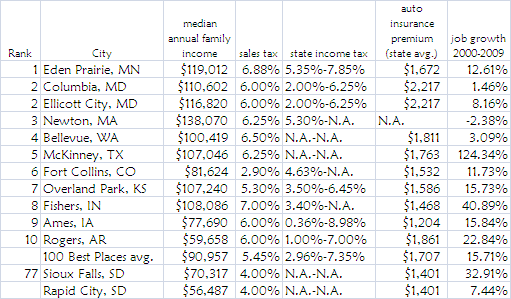
No. Surveying 752 cities of population 50K to 300K, Money crowns Eden Prairie, Minnesota, as the best little burg. Sioux Falls ranks 77th. Rapid City doesn't make the top 100.

Here's how Sioux Falls and Rapid City stack up against the top 10 cities on the list and the average metrics for the top 100:


Note that Money fails to include city sales tax for Sioux Falls and Rapid City. But tax rates apparently don't matter much: Minnesota's relatively high income tax doesn't keep Eden Prairie from ranking #1... or Plymouth, Woodbury, Egan, or Apple Valley from making the top 20.

Fargo, Lincoln, and Cedar Rapids all beat Sioux Falls with cheaper median housing prices. Grand Forks, Bismarck, Dubuque, Ames, Missoula, Rochester, and Cheyenne all beat Sioux Falls for shorter commute time (which makes sense, given how dependent Sioux Falls is on workforce driving from Harrisburg, Dell Rapids, Madison, and elsewhere). Sioux Falls doesn't even make the top 25 for clean air, falling behind Ames, Bismarck, Lincoln, Fargo, and even refinery-happy Cheyenne (uh oh: I feel a Hyperion argument coming on).

Sioux Falls does come out on top for job growth over the decade, thanks to Lincoln County's 67% job boom. Sioux Falls is also the 20th coldest city on the list (though Minnesota still beats the snowpants off us in this category, too).

Some nice places Sioux Falls beat overall:
  • Fargo (#86) but not Bismarck (#74)
  • Sioux City (as if there were any doubt)
  • Duluth
  • Green Bay and Milwaukee
  • Madison, Wisconsin (#95)
  • Kalamazoo
  • 15 out of 17 cities in Ohio
  • Boulder, Colorado (wait a minute—Boulder, you should call for a recount)
  • Orlando, Fort Lauderdale, Daytona Beach, and Boca Raton (seriously!)
  • every place in Oregon!
Peruse the full report yourself... and eagerly anticipate Mayor Huether's appearance at his next press conference wearing a #77 Fighting Pheasants jersey.

----------------------
Related: South Dakota fails to make the list of the 2010 Digital Counties Survey Awards from the Center for Digital Government. Minnesota's Hennepin, Dakota, and Olmsted counties make the top-ten lists in their respective population groups. Half of South Dakota's counties don't even have websites.

Saturday, July 3, 2010

SD Mines Beats SDSU for Return on Investment; Black Hills State Last

Bloomberg Businessweek has released an analysis of the financial return on investment at over 500 American colleges and universities. Their major finding: overall, estimates of how much more you'll make with a college degree than without are vastly overestimated:

But new research suggests that the monetary value of a college degree may be vastly overblown. According to a study conducted by PayScale for Bloomberg Businessweek, the value of a college degree may be a lot closer to $400,000 over 30 years and varies wildly from school to school. According to the PayScale study, the number of schools that actually make good on the estimates of the earlier research is vanishingly small. There are only 17 schools in the study whose graduates can expect to recoup the cost of their education and out-earn a high school graduate by $1.2 million, including four where they can do so to the tune of $1.6 million. At more than 500 other schools, the return on investment, or ROI, is less—sometimes far less. College, says Al Lee, director of quantitative analysis at PayScale, "is not the million-dollar slam dunk people talk about" [Francesca Di Meglio, "College: Big Investment, Paltry Return," Bloomberg Businessweek, 2010.06.28].

The study analyzes ROI for in-state and out-of-state students separately, so public schools get two rankings. It measures ROI at three South Dakota schools: South Dakota State University, School of Mines and Technology, and Black Hills State (alas! no comparisons with DSU or Augie).


School of Mines comes out on top in South Dakota and pretty good nationwide. the ROI resident students get ranks 288th out of 852 rankings in the analysis. Non-resident ROI ranks 294th.

South Dakota State University ranks 580th by resident rates and 598th by non-resident rates. SDSU's ranking is helped by its 51% graduation rate, compared to a 37% graduation rate at Mines. But interestingly, SDSU graduates make little more than Mines students who don't graduate. Among non-residents, Mines non-grads actually edge SDSU grads in ROI. Sometimes, winning is just a matter of showing up.

The worst way to invest your educational dollar is to come from another state and attend BHSU. The ROI for non-residents at Spearfish ranks 852nd out of 852. South Dakotans attending BHSU do only marginally better, producing an ROI that ranks 850. In other words, if you're concerned strictly about earning potential and you're thinking about attending Black Hills State, you might do just as well to skip college, go straight to work, and make up the earning difference by putting in extra hours for a couple summers at Zesto's.

The best investment in the region is private Carleton College over in Northfield, Minnesota. And alas, even with lower tuition, SDSU lags behind the flagship public universities of Minnesota, Nebraska, and North Dakota.

Now a couple notes on methodology:
  1. This analysis examined 1.4 million graduates, but the data is self-reported, allowing for all sorts of inaccuracy.
  2. The return on investment includes assumes earning power is delayed, figuring that if you don't go to college, you spend those first four years out of high school working your tail off.
  3. The overall ROI is more a measure of the institution's performance, not specific graduates. Having lots of students who don't graduate counts against a school's ranking, but it doesn't change the fact that if you get that degree, you will earn more.
Oh yeah, best return on investment: Massachusetts Institute of Technology. MHS grad Mike Stunes will be rolling in dough in a few years!

Sunday, June 13, 2010

SD Wind Farms Growing; Aberdeen News Blows Conservative Smoke

So I'm reading through a nice little article in the Aberdeen American News about the continued growth of wind farms in South Dakota. 413 megawatts installed, another 300 megawatts under construction, still lagging other states, need for transmission and customers to drive more development... the usual. Public Utilities Commissioner Dusty Johnson does note that by the end of the year, South Dakota will have enough wind power capacity to keep the lights and laptops on in more than half of our homes. Not bad!

But then I hit a speed-reading bump:

Many planned wind farms were going to tap into the Big Stone II coal-burning power plant that was going to be build near Milbank. Before it was stymied by out-of-state environmental groups, it was to include extra transmission capacity for locally produced wind energy [Emily Arthur-Richardt and Scott Waltman, "Slowly growing: Wind farms gradually increasing in South Dakota," Aberdeen American News, 2010.06.13].

What?!? The allegedly objective professional journalists of the AAN get to drop this ideological talking point into their report as an unsubstantiated dependent clause? Did Emily crib this line from AAN salesman and conservative blogger Dan? Is all of South Dakota's press in bed with the fossil-fuel industry?

For the umpteenth time: Big Stone II was not killed by hippies, Luddites, or envirowhackos. Big Stone II died because backers failed to make the business case. Project backers consistently underestimated costs. Otter Tail and other investors saw they could meet growing power demand with wind and conservation for less cost than sinking money into a big new coal plant. Their thinking matched the thinking of sober-eyed capitalists like Bill Gates and Warren Buffett who see big fossil fuel projects don't promise a sustainable return on investment.

And for what it's worth, environmentalists were trying to help by pushing to pass a clear energy policy, but Senator John Thune and his obstructionist pals have held up the legislation that the Big Stone backers themselves were saying would have been good for their project.

Of course, the loss of Big Stone II was not accompanied by the sound of wind turbines grinding to a halt. Killing Big Stone II was good for wind power, for the environment and the economy. One report says there's twice as much new wind power in development in Minnesota than would have been generated by Big Stone II. Just last month, Dakota Wind Energy received initial approval to use 300 megawatts of the transmission reserved for Big Stone II. Onward and upward, thanks to entrepreneurs and environmentalists who won't let ideology (or biased press) stop them from getting the job done.

-------------------------------
Update 2010.06.16: But wait, there's more: The PUC just approved another South Dakota wind farm, Basin Electric's PrairieWinds SD1. With 101 turbines turning out 150 megawatts, PrairieWinds SD1 will succeed Basin Electric's big North Dakota wind farm as the largest cooperative-owned wind farm in the U.S. They'll build 13 miles of new transmission to hook into WAPA's current grid.

Wednesday, May 26, 2010

North Dakota Chats up South Dakota; Minnesota Ignores Us

Rebecca Blood turns my attention to Lexicalist.com, which analyzes online text and demographics to figure out who's talking about what where. You type in a word, Lexcialist calculates the prevalence of that word in online conversations by state, sex, and age.

So I type in South Dakota. The results:


Lexicalist.com ties most of the conversation about South Dakota, 81.2%, to speakers/bloggers/tweeters in South Dakota. Among outsiders, we figure most prominently in the consciousness of our northern neighbors: North Dakotan online sources contribute 6.2% of mentions of "South Dakota (certainly 5.2% are prefaced with the phrase, "Gee, why can't we be more like..."). Wyoming produces 4.0% of South Dakota mentions; Iowa 2.5%. Our Minnesota neighbors provide only 0.7% of South Dakota mentions, a tick fewer than even Montanas make... and Montanans have Yellowstone and the Rockies to distract them. Minnesotans talk about North Dakota twice as much. What gives?

Plug "Minnesota" into the Lexicalist search query, and you find that Minnesotans provide only 35.3% of their own mentions. 13.0% come from North Dakota, and 10.2% come from South Dakota. (I leave it to the Minnesota Department of Tourism to speculate as to what words precede our mentions of our easterly neighbor.) Hmmm... are South Dakotans more self-absorbed than Minnesotans? Mentions of Minnesota are more spread out among other states, suggesting their marketing and top-of-mind-awareness are better than ours... or that they just get more online press thanks to the Twins.

One more random note for the watercooler: The three states that talk about New York the most are New York (12.6% of mentions), New Jersey (5.7%), and North Dakota (4.3%). South Dakota ties with Alaska for talking about New York the least, not even registering on Lexicalist's count. Hmmm....

Tuesday, April 27, 2010

Excel Dairy Permit Denied; Veblen Dairy Dozen Declaring Bankruptcy in ND, MN

Just one minute ago, the Minnesota Pollution Control Agency unanimously affirmed these findings of fact and upheld the denial of permit to Excel Dairy in Thief River Falls, Minnesota.

This denial comes on top of a month of deep doo-doo for Veblen's Dairy Dozen. The company has filed for Chapter 11 bankruptcy on its Five Star Dairy near Milnor, North Dakota, and on its Excel Dairy near Thief River Falls, Minnesota. Excel Dairy was shuttered due to environmental violations (review the file on that mess at the Minnesota Department of Health and the Minnesota Pollution Control Agency's proposed findings of fact).

These filings come in addition to a Chapter 11 filing for the Veblen West CAFO this month and the placement of the Veblen East CAFO in receivership in March. Dairy Dozen chief Rick Millner says the bankruptcy filings are a legal business strategy to keep the doors open and maintain the possibility of paying creditors:

“We could quit and walk away from it and nobody would be getting paid,” [Millner] said. “Or we can reorganize and get our plans put together with everyone getting paid in full. As long as we are in the fight, we can pay people. As soon as we get knocked out, people are going to go unpaid” [Kevin Bonham and Stephen J. Lee, "Excel Dairy Hearing Set for Tuesday in St. Paul," Grand Forks Herald via Agweek, 2010.04.26].

With Excel dairy's permit denied, Millner has fewer doors to keep open. Let's hope the courts can still hold him accountable for bad environmental and business decisions and make sure the Dairy Dozen's creditors get paid their due.

Sunday, February 7, 2010

Excel Dairy Victims Take Protest to Minnesota Legislature

MN Pollution Agency Documents Violations at Six Millner Feedlots

More for the Rick Millner-rotten neighbor file: Thief River Falls residents testified before their State Senate Health Committee in St. Paul last week about Excel Dairy, the feedlot whose disregard for neighbors, environment, and legal authority has stunk innocent folks out of their homes.

[Jeff] Brouse and his neighbors described an odor so pungent it goes beyond a normal manure smell. Health Department officials told of hydrogen sulfide levels so high they not only go beyond their meters’ capacities, they are so high that doctors do not know how they might affect people.

Health officials have advised residents near the dairy along U.S. 59 in northwest Minnesota’s Marshall County to evacuate their homes several times.

Six-year-old Brooke Fredrickson told senators that it is not fair that on nice, sunny days she often is forced to play inside her home because of the smell and accompanying health danger. She needs to go inside “when my eyes get crusty.”

Looking at her little brother, Jake, she added: “I am his big sister, and I need to protect him” [Don Davis, "Cleanup delay at Thief River Falls dairy site draws protest," AgWeek, 2010.02.04]

Just as Excel Dairy has flaunted EPA regulations, it has flagrantly defied the orders of the state of Minnesota:

Cows were removed from the dairy after an agency order a year ago. Excel has not fulfilled another part of the order to clean up three manure lagoons that still emit gases, Assistant Attorney General Jeff Grell said.

The dairy also left a pile of feed on the property, in defiance of the state, he said, and rats and other animals have moved in [Davis, 2010].

Read more about Excel Dairy's "history of failing to comply with the requirements of its permits," as well as delay, deception, and what sounds perilously close to outright lying, in this report from the Minnesota Pollution Control Agency. This MPCA report also documents violations of permits and environmental rules at five other dairies Millner has been involved with, including his big operations near Veblen, South Dakota.

The record is clear: Rick Millner's feedlots are trouble. He has operated at least six feedlots with apparent disregard for the law, the environment, and his neighbors. We can only hope MPCA will follow through with its intention to deny Millner another permit for his Thief River Falls feedlot.

Monday, January 4, 2010

Why Minnesota Beats South Dakota: Taxes Invest in Public Goods

Reading (and questioning) the Small Business & Entrepreneurship Council's report on which states best conform to its ideological wishlist for policies that favor business reminded me of a report I cited a couple years ago in a discussion of South Dakota's upside-down tax system that taxes food but not gold. The latter report, by Dr. Robert G. Lynch, finds that the anti-tax, anti-government logic used by the SBEC to rank South Dakota #1 for entrepreneurship is flat wrong. Lynch argues that the public services provided by an adequate tax base add more value to the business climate than tax cuts that reduce public services:

Businesses need to know that they can rely on high-quality, well-administered public services to facilitate the conduct of their enterprises. Roads, bridges, and highways must be maintained in good repair; ports and airports must be large enough to handle transportation needs; sewage systems must be adequate to meet the needs of existing firms and expandable to service prospective businesses; snow removal and flood control must be reliable and timely; fire protection and police services must be ready when needed; the justice system must be professional, impartial, and quick to resolve contract disputes; and the schools and colleges must help to generate a skilled and well-trained workforce. A relatively crime-free state with high-quality public services—including good infrastructure and a highly educated workforce—will have an excellent business climate.

Minnesota, despite its relatively high business tax burden, is a good example of this. Compare Minnesota to its neighbor South Dakota, which has a relatively low business tax burden. As the Property Tax Study Project (2000) has noted, Minnesota has had higher per capita income after taxes, higher average hourly earnings, higher average annual pay growth, higher employment growth, more high school and college graduates per capita, better maintained roads and bridges, less income disparity, and a lower business failure rate than South Dakota. Indeed, Minnesota can be said to have a good business climate in part because of its relatively high tax burden, while South Dakota has a weaker business climate in part because of its relatively low taxes. Taxes are necessary to pay for the high-quality public services that make a state a good place to do business [emphasis mine; Robert G. Lynch, "Rethinking Growth Strategies: How State and Local Taxes and Services Affect Economic Development," Economic Policy Institute, 2004, p. 12].

Note that last part in bold: lower business failure rate. SBEC's argument is all perception; Lynch and I are looking at reality, actual business performance. Say what you want about how you think low taxes make a better business climate; when businesses fail at a higher rate in South Dakota than Minnesota, Minnesota clearly has the better business climate. The strategy of trying to attract businesses with tax breaks is likely to backfire:

...[I]t is unlikely that business decision makers are apt to be persuaded by “perceptions” rather than by the facts of business costs and benefits. In any case, firms that are driven appreciably by perception and are less attuned to the facts about costs and benefits are likely to be unsuccessful and few in number, as they tend to get driven out of business by their more savvy competitors. Attempting to attract such businesses by giving them tax breaks is probably not a wise investment on the part of state and local governments [Lynch, 2004, p. 11].

This EPI report is perfect counter-programming to the SBEC report. SBEC's chief economist Raymond J. Keating has a master's degree; Lynch is an actual Ph.D. Lynch and his fellow Ph.D. researchers at EPI get published in academic journals. SBEC is a right-wing advocacy group; EPI is a pro-labor group whose founders included reasonably intelligent former Secretary of Labor and fellow lefty Robert Reich.

As Dr. Lynch notes, we shouldn't always think of taxes as a "burden." They can be a way to save money... by subcontracting the government:

When tax cuts cause reductions in public services, firms may be forced to spend more on, for example, the education and training of their workers, health services for employees and their families, security for the workplace, and infrastructure. As a consequence, in the absence of adequate taxation, the provision of “public” services becomes an internal cost to firms. Moreover, the costs of providing these “public” services privately, in the relatively small amounts needed by individual firms, may be much higher than the costs of providing them collectively to all firms by government. For example, it may be cheaper for a city to provide police protection to all firms located within its borders than it would be for each firm to pay for its own security force. Thus, tax cuts and incentives may not reduce the costs of doing business but may, instead, contribute to rising costs by reducing publicly provided services [Lynch, 2004, pp. 5–6].

A business may not like paying taxes, but it would like hiring its own cops, teachers, and pavers a whole lot less.

Low-tax policy is a money loser for South Dakota in more ways than one. Consider that state and local taxes are deductible from federal income tax:

Typically, for every dollar of tax revenue lost by a state or local government due to tax cuts and incentives, firms increase their revenues by only about 60 cents. Due to the deductibility provisions of the tax law, the other 40 cents go to the federal government and other state and local governments in the form of higher tax payments. Ironically, therefore, state or local tax cuts and incentives subsidize competing jurisdictions by providing them with additional tax revenue [Lynch, 2004, p. 16].

So the next time you hear Governor Rounds or some right-wing advocacy group pontificating about how South Dakota's "low taxes" are good for business, tell them to look at reality in the form of Minnesota and Lynch's report.

Tuesday, October 27, 2009

Sun-Worshipping Son Worshippers: St. John's Monks Bring Solar to Prairie

I've been so busy focusing on wind power (you're thinking, what do you expect from a windy guy like Cory?) that I've ignored another potential boon for alternative energy in South Dakota: solar power.

But don't take my word for it: talk to the brothers at St. John's Abbey in Minnesota. They're doing the Lord's work by building the biggest experimental solar farm in the upper Midwest. By the end of November, the abbey will have installed 1820 solar panels on 3.9 acres next to their campus. The panels will use a tracking system that turns them toward the sun, boosting juice by 15%. The system will generate 575,000 kilowatt-hours of electricity, the equivalent of the power used by 65 homes.

Put that in local perspective: we could cover the old beanfield in the middle of which our house sits with similar panels and generate power for every house on the west side of Lake Herman.

Now sure, we have our cloudy spells, just like we have our calm spells when wind turbines won't spin. But South Dakota's weather is a lot like Minnesota's—if I'm reading this map right, South Dakota actually has better solar potential than Minnesota, and the monks in Collegeville are making a go of solar. This fact sheet provided by St. John's Abbey says solar power is a great fit for our neck of the continent:
  • Minnesota (and thus South Dakota) has better solar resource available than Germany, yet Germany leads the U.S. in solar energy production.
  • Solar power depends on electronics, and electronics run better in cooler weather.
Cooler weather—know any place with weather like that?

Nathan Franzen of Westwood Renewables, the Eden Prairie outfit helping the brothers get some sun, makes the sale for you shadowy skeptics:

Franzen said most people don't think Minnesota is a good area for solar energy technology, but it actually is.

"The main reason for that is that solar works more efficiently in cooler temperatures," said Franzen. "So if you take this solar system and put it in New Mexico, on the same sunny day, it will actually produce more in Minnesota because of the cooler temperatures than it will on a hot day in New Mexico" [Ambar Espinoza, "St. John's Abbey Gets Upper Midwest's Largest Solar Farm," Minnesota Public Radio, 2009.10.07].

Xcel Energy, the same folks greening the Metrodome with wind power, is supporting this solar project with a $2-million Renewable Development Fund grant.

And why are the Benedictine brothers so committed to getting their solar freak on?

The Benedictine tradition at Saint John's Abbey advocates a strong commitment to good stewardship of its resources. Incorporating solar energy to the campus's energy sources is the first major step in the Abbey's initiative to broaden and strengthen the monastic community's commitment to green energy-and to education.

Just two years ago, under then-president Br. Dietrich Reinhart, Saint John's University was a charter signatory of the American College and University Presidents Climate Commitment in 2007, which directs Saint John's to the ultimate goal of carbon neutrality as part of an ongoing commitment to good stewardship.

Saint John's Abbey and Saint John's University see themselves as responsible for the campus's natural environment and seek to take a leadership role in educational activities to promote environmental awareness, global thinking, and collaboration on the local level ["Saint John's Abbey Goes Solar! Construction on Solar Photovoltaic Project to begin in October 2009"].

Even conservatives can recognize that this kind of environmentalism isn't a secular humanist plot to destroy America. Local solar power, right alongside wind and other alternatives, is good Christian thinking: making the best use of the resources we have and doing good for the community.

----------------------
p.s.: President Obama is announcing $3.4 billion in grants to promote smart-grid technology... exactly the kind of tech that will make distributed solar and wind generation more useful.

pp.s.: Not that you need any more reasons than local self-sufficiency and ending dependence on fossil fuels to say, "Go monks, go solar!" but you know that story fueled by Drudge and the new Freakonomics book that the last ten years have brought a cooling trend, meaning action on climate change is just silly? An independent statistical analysis finds that claim bogus. "The last 10 years are the warmest 10-year period of the modern record," said NOAA climate monitoring chief Deke Arndt. "Even if you analyze the trend during that 10 years, the trend is actually positive, which means warming" [Seth Boronstein, "Analysis Rejects 'Global Cooling' Claims," AP via MPR.org, 2009.10.26].

Wednesday, October 7, 2009

Millner and Excel Dairy Defy EPA, Violate Clean Air Act

I've previously reported that Millner's Thief River Falls operation has continued to violate state air quality standards and the conditions the Minnesota Pollution Control Agency laid out when it put Excel Dairy on a short leash this year for frequent air quality violations in 2008.

Now this document turns up: a letter from the United States Environmental Protection Agency, dated June 26, 2009, finding Millner and Excel Dairy in violation of the federal Clean Air Act. The EPA violation has been reported previously. But it is important to understand that the violation is not just mismanagement of tons of manure and emission of excessive hydrogen sulfide. In the letter and notice of violation to attorney Matthew A. Slaven, Region 5 EPA Air and Radiation Division Director Cheryl L. Newton offers evidence that fits Millner's pattern of apparent disregard for the law:
  • In 2008, the EPA found Excel Dairy and specifically Prairie Ridge Management and Richard Millner in violation of the Minnesota State Implementation Plan at the dairy.
  • Air quality monitoring demonstrates that Excel Dairy, Prairie Ridge, and Millner continued to violate Minnesota SIP Rule 7009.0080 "on numerous days beginning in April 2009."
  • In December, EPA ordered Millner and Excel Dairy to reply to a 53-item information request, including a requirement to "begin conducting hydrogen sulfide ambient air monitoring at the Thief River facility." The EPA gave Millner and Excel Dairy 30 days to comply.
  • After six months and two more EPA letters, Millner and Excel Dairy had failed to fully comply with the December order.
As of the June 26 letter, Millner thus stood in violation of Section 114(a) of the Clean Air Act, 42 U.S.C. § 7414(a).

Maybe my libertarian friends will praise Millner for poking a stick in the EPA's eye with his apparent delays and non-compliance. But like Roman Polanski, Millner and Excel Dairy double their crime by defying the efforts of legal authorities to hold them accountable for polluting Thief River Falls and infringing on the liberty of their neighbors.

--------------------------
Meanwhile, up in Veblen, Millner has been having manure drainage problems. In August, he received permission from the Marshall County Commission to bore under County Road 1 to increase drainage from his property. Why doesn't that sound good to me?

Sunday, October 4, 2009

If You Give Rick Millner a Cookie...

...he'll keep crapping all over you.

Last January the State of Minnesota shut down the Thief River Falls Excel Dairy, owned by Veblen, SD, dairy entrepreneur Rick Millner and the Dairy Dozen. The reason: stink-bombing the county so badly that neighbors had to evacuate their homes. The Minnesota Pollution Control Agency graced the recalcitrant and litigious Dairy Dozen with a restricted one-year permit to get the Excel Dairy's act together.

So, a business violates the law, intrudes on other citizens' property rights without compensation, and the state gives them another year to clean up their act. What does the state get?

Between Aug. 29 and Sept. 21, the facility surpassed the state limit for hydrogen sulfide emissions of 30 parts per billion on 10 occasions, according to Gaylen Reetz, Minnesota Pollution Control Agency regional director. The highest reading during that period was 46, or more than 50 percent higher than the legal limit [Kevin Bonham, "State Finds TRF Dairy in Violation—Again," Grand Forks Herald, 2009.09.29].

Rick Millner and Excel Dairy have a legal permit. They have legal conditions. They have obligations to fellow citizens to run a clean operation. Instead, they take advantage of the state's generosity and repeatedly break the law. They continue to demonstrate they cannot effectively manage their own manure and conduct business within the law.

South Dakota should be embarrassed to have any connection with businessmen like these. The State of Minnesota should shut down Excel Dairy for good, and the law-breaking owners should get fines and jail.