We've moved!
DakotaFreePress.com!

Social Icons

twitterfacebooklinkedinrss feed
Showing posts with label culture. Show all posts

Friday, November 19, 2010

Libraries Still Relevant: Keep Reading (and Paying Your Taxes)

The other day I had an engaging conversation with an eager reader on the street who wondered if many of our fellow South Dakotans are doing any reading and thinking when they vote.

I can't speak to the thinking, but Mr. Gebhart points to encouraging evidence of reading:

The role of libraries and their reinvention is, I think, documented by what Siouxland Libraries has seen since renovating and expanding its main branch. The first six months since the main branch reopened to the public saw record use. During that time, the main library had close to 7,000 visitors a day and patrons borrowed nearly 267,000 items, a 17 percent increase over the same time period in the last year of normal operation. It’s clear the demand isn’t just for printed material. For example, there were almost 54,000 sessions of computer use during that period, meaning the computers there are being used roughly 300 times a day [Tim Gebhart, "Library Dealing with Reinvention Curve," A Progressive on the Prairie, 2010.11.18].

I'll take that as cause for cultural optimism. People want to learn. We need books and libraries and free public Internet access for that learning. In a democracy that depends on educated voters, we have a community obligation to pay for good libraries.

Sunday, November 14, 2010

Got Talent? Leave. South Dakota Prefers Mediocrity

One of our state legislators has said something stupid. No, I'm not referring to compliments paid to Russell Olson upon his selection as Senate Majority Leader. I'm referring to the following quote reported by Bob Mercer:

A member of our Legislature took issue with a recent writeup on this blog regarding why election losers leave public service and sometimes leave South Dakota altogether. Regarding Stephanie Herseth Sandlin, the fellow told me, “She’s got too much talent to stay here” [Bob Mercer, "She's Got Too Much Talent...," Pure Pierre Politics, 2010.11.13].

Too much talent... The statement itself makes no sense. There is no such thing as too much talent. No rational person ever says, "Gee, I wish I or my kids or my employees or my elected officials had less talent."

The unnamed legislator's comment could have come straight from "Harrison Bergeron." Does this unnamed legislator somehow believe that South Dakota doesn't deserve to have talented people in office? If so, I'd love to know who got this legislator's vote for party leadership this weekend. Would South Dakotans really choose less talented leaders over more talented leaders and accept years of drifting caretaker government and half-hearted initiatives that fall apart?

This legislator is perpetuating the South Dakota inferiority complex, that weird mix of perverse humility and anti-intellectualism that tells smart kids they are somehow un-South Dakotan. This legislator reminds me of Russell Olson, who has occasionally pointed out while campaigning here in District 8 that he didn't get the best grades in school. Generally, rational candidates say things they believe will make themselves look like better candidates. Granting that Olson is rational, I conclude that Olson thinks that emphasizing a lack of academic talent makes him look better among South Dakota voters. We're no good, so no one else should strive to be, because that would only make us feel more ashamed of ourselves.

What, then, do legislators with this anti-talent mindset really think about programs like Dakota Roots, the Sanford Homestake Lab, the Opportunity Scholarship, or education funding in general? These programs and others all seek to maintain and expand South Dakota's talent pool. If a legislator believes that individuals like Stephanie Herseth Sandlin have "too much talent" for South Dakota, then why would a legislator want to spend any tax dollars to recruit more talented workers or to encourage smart kids to go to college in state? Perhaps the Opportunity Scholarship needs a new ACT threshold: instead of a minimum score of 24 to qualify, we need a maximum score of 30: do better than that, and you're clearly too talented to go to SDSU. (By the way, Stephanie, what was your ACT score? And Kristi, how about you?)

There are other even less flattering ways to read this unnamed legislator's comment. Maybe this legislator thinks that a state full of mediocre thinkers and workers is easier to control and pay minimum wage. Maybe this legislator is a bitter Democrat (or one of the disaffected Republicans that my own unnamed sources say have no love for Kristi Noem) calling 48% of the electorate stupid. Maybe this legislator is just rationalizing our narrow rejection of Herseth Sandlin at the polls into a conscience-soothing compliment—"Nothing personal: we threw you out because you're so darned good! Now please go away, sweetie, and stop reminding us how dumb we are."

Whatever the beliefs motivating it, no good comes from this legislator's statement that Herseth Sandlin has "too much talent" for South Dakota. It says to our Fargens, our Buhls, our Venhuizens, and our Webers, "You don't belong here. Get out."

I do not believe South Dakota is a land of mediocrity. But legislators like the one talking to Bob Mercer will make us one.

Thursday, November 4, 2010

Mortenson: Withdraw 248 U.S. Soldiers, Fund All Afghan Higher Ed

Greg Mortenson at SDSU 2010.11.03A full house at Frost Arena greets Greg Mortenson as he preapres to speak at South Dakota State University, November 3, 2010
The Heidelbergers joined about 5000 other people at SDSU's Frost Arena last night. Nary a basketball in sight: we gathered to hear author, adventurer, humanitarian (and ELCA Lutheran!) Greg Mortenson talk about how to save the world one conversation and one school at a time.

The author of Three Cups of Tea and Stones into Schools offered a lot of practical and political insight into what's happening in Afghanistan and Pakistan, and what we Americans might do to make it better.

Mortenson is an Army veteran, so he has great respect for and understanding of the military. This old soldier said there is no military solution to ending the Taliban's terrorism and oppression of women in Afghanistan and Pakistan and bringing our soldiers home. Asking our 18-year-olds to be soldiers is hard enough; asking our young soldiers to be diplomats and humanitarians at the same time, says Mortenson, is an enormous burden. Building some sort of peace in Afghanistan and Pakistan requires something more.

The military gets this. Mortenson said that General Petreaus has made Three Cups of Tea, about Mortenson's efforts to build relationships with village elders and build schools for girls in Afghanistan and pakistan, required reading for senior military officials. The U.S. military also brings Mortenson to 28 military bases a year to conduct briefings for Afghanistan-bound troops on local culture.

Mortenson sees education, especially education for girls, as the key to peace throughout the world's poorer and less stable countries. Educating women leads to lower infant mortality, increased literacy, and a decrease in population growth. Mortenson says flatly that there are too many people on the planet (cue awkward shifting from some audience members). He says we can lessen the strain on our natural resources without any controversial policies. He's not mandating forced birth control or limits on family size. He believes letting girls go to school will result quite naturally and justly in those girls growing into women who assert their rights to control their destiny, to work and participate freely in the economy and culture, and to have fewer yet healthier children.

Mortenson puts into financial perspective how easy it would be for the U.S. and the West to shift from military to humanitarian solutions. President Obama doubled our troop presence in Afghanistan last year to 100,000 pairs of boots on the ground. At $100 billion a year, that's $1 million per soldier. Mortenson says he asked the Afghan minister of education to cite a dream budget for the country's higher education system. $248 million a year, said the minister. Bring 248 American soldiers home, and you'd have the money to fund all 24 of Afghanistan's universities, and then some.

Or try this: Bring five soldiers home. Use the corresponding five million dollars to build an Afghan version of South Dakota School of Mines and Technology. Train a new corps of Afghan engineers and geologists to lead the country's exploitation of newly discovered rare earth minerals and other ores that could be worth hundreds of billions. Let Afghanistan make itself rich, says Mortenson, with a meager investment in education.

Or why not aim even bigger: Mortenson says that worldwide, 120 million children are not in school. 78 million are girls. Millions of them are slaves, bought and sold to produce rice, soccer balls, fireworks, and many other things we use. Educating one child takes a few dollars a day in some places. Mortenson says spending $60 billion dollars over the next ten years would eradicate worldwide illiteracy. That's $6 billion a year—no small sum... but only 6% of what we spend each year making war in Afghanistan.

Mortenson said the Taliban fear education—an awkward position for such supposedly pious men, as Mortenson cites a line from Muhammad declaring the ink of the scholar holier than the blood of a martyr. Holy or not, smart people, especially smart women, are the enemy of their fear- and force-based power. Since 2007, the Taliban have destroyed 2400 schools, three quarters of them girls' schools.

But Mortenson says the Taliban have yet to destroy one of the schools he's helped start in the region, in large part because he gets the locals themselves to build the schools. And overall, Afghanistan's greatest success under American/NATO occupation is in education. Mortenson says that in 2000, 800,000 Afghan children, mostly boys, were in school. In 2010, nine million Afghan children are in school. 2.8 million of those children are girls. That's still a terrible imbalance, but it's enormous progress from when the Taliban held Kabul.

Typical political labels don't fit in this discussion. But for those of you blog readers addicted to such things, Mortenson is no big-government liberal. He said our initial top-down approach to rebuilding Afghanistan, the Bonn Agreement, failed because it was too centralized. Mortenson said the post-World War II Marshall Plan was "brilliant" because it was decentralized and provincialized. Mortenson said General Petreaus boils his model for building a healthy and peaceful Afghanistan down to three bullet points: listen, respect, and build relationships with the people, especially with the elders. Ultimately, said Mortenson, people in Afghanistan and Pakistan want the same things we do: they want their children to live, and they want their children to learn. We can help make that happen, but we will do it with brains, not bullets.

Monday, September 13, 2010

Brookings Children's Museum: Bang! Splash!

Brookings enjoyed picture-perfect Sunday weather for the opening of its amazing new Children's Museum.

The Brookings Children's Museum is on the site of old Central Elementary, just one block east of downtown. Within a two-block radius of this remarkable facility, you can walk to the public library, the community arts center, the bike shop, Nick's Hamburgers, the used book store, and George's Pizza... assuming you can manage to get through all of the activities in the children's museum. Walk a couple more blocks, and you can catch a movie. All Brookings needs now to complete the downtown tourism picture is a nice downtown hotel.

Both of us think the hanging sculptures in the bright, sunny atrium are wonderful.

A big crowd hung around after the museum closed to hear Recycled Percussion give an outdoor concert. The musicians took a break from their gig at the MGM Grand in Las Vegas to open the museum with a bang. Several bangs, actually.

Among the crowd enjoying the museum and music: Brookings resident Congresswoman Stephanie Herseth Sandlin, who made time after the Habitat dedication to bring her son Zachary and dad Lars to the museum. Both Herseth gents report enjoying the water farm immensely.

Saturday, August 7, 2010

Miracle Treat Day Lessons for Creative Community Development

When I blog about Miracle Treat Day at the Madison Dairy Queen, I try hard not to politicize the event. Madison DQ owner DeLon Mork and his crew continue to lead the nation in making the fundraiser a success: the store sold 20,955 21,405* Blizzards for the Children's Miracle Network on Thursday. Dairy Queen and the community do good for sick kids and their families—that's the main story, and all the story there needs to be.
line for BlizzardsPatience is a virtue: the line for Blizzards at 7:30 p.m. snakes around the entire inside of the Madison DQ and out the door to the sidewalk.

But if we want to broaden our focus—and I think we can without doing injustice to the event itself—the success of Miracle Treat Day in Madison has some lessons for creative community development in our small town and other rural communities.

I think a lot about how Madison and other small towns can throw successful cultural events that enliven our downtown. I don't have to think that hard: the Madison Dairy Queen pretty much shows a small town how to throw a party. What do we learn about staging good community cultural events from Miracle Treat Day?

Crowded behind the DQ counterBusy behind the counter: Madison Dairy Queen runs at full staff and then some during Miracle Treat Day
First, even when you're small, don't hesitate to think big. South Dakota has bigger Dairy Queens with more seating, more counter space, and kitchen space. That hasn't stopped DeLon and his crew from increasing sales and turnout each of the five years they've done Miracle Treat Day. Staff work shoulder to shoulder behind the counter; customers wait shoulder to shoulder at the counter and in the line that snakes through the entire store and out to the sidewalk. Customers wait patiently. Midwesterners overcome their customary outsized prairie bubbles and accept some Manhattan-style crowdedness for a few minutes. You can do more with your space than you think.

parking up Harth AvenueParking is everywhere: folks parked a block or more away up Harth Avenue to come get Blizzards and enjoy the music.
Corollary: parking is not as big a deal as you think. There's no way the Madison DQ parking lot could hold all the people who come to the store on Miracle Treat Day, let alone everyone who comes to listen to the music and bring their kids for the games on adjoining Harth Avenue. If you don't have a big parking lot for the community event you're planning, do you give up? No. You make it big enough and good enough that people will be willing to walk. I saw cars parked up and down Harth Avenue Thursday night... about as far as people walk to cross the parking lot to Hy-Vee or Wal-Mart in the big city. People walk a lot farther to get to the Brookings Summer Arts Festival. Don't sweat parking! Throw a good enough event, and people will burn shoe leather to get there.

MPD directs traffic on Hwy 34 outside DQMadison police direct traffic on Highway 34 outside the Madison Dairy Queen. Note the signs and the fire truck boom, getting drivers' attention from blocks away so they know they'll need to slow down.
Culture shift: Take back the streets. All those visitors mean drivers will see something they aren't used to in a small town: lots of people walking around, enjoying themselves, and taking up valuable space on the sidewalks and the streets. We rural drivers get used to thinking of stop signs as the only obstruction to our unimpeded travel. The streets sometimes figure in our psyche as inviolable spaces for machines only.

Nuts to that. Plan that big event. Get the city to barricade a block or two. Draw a crowd that spills over from the sidewalk to the boulevard to the street. Get a couple city cops to come direct traffic. Trust me: if your town is Madison or any similar size, the police aren't too busy to come help. Besides, what more logical place for the police to do their job of protecting the public than the big event where you've got the biggest concentration of the public? Put up the signs, get drivers' attention, slow them down, remind them that the streets belong to the entire community, not just people in cars.

Solve problems. The bigger your plan, the more moving parts you install, the more unforeseen problems you'll have. This is not a reason to plan small. This is a reason to think ahead, brainstorm anything and everything that could go wrong... and still be ready to come up with solutions when the problems you inevitably can't foresee arise. Don't be scared: be excited! A big event is a chance to say, bring it on! I can fix anything!

lift by Masonic TempleMadison Masonic Temple gets a new elevator... with a view!
Consider Thursday: M.O.B. thought it would be cool to play some music from the roof of the Masonic Temple across from the Dairy Queen. DQ owns the temple, and DeLon said, "Sure, why not?" But dang—how do we get the band's equipment up there? Call a friend with a telehandler. Problem solved! and that great old vacant building gets its first practical use in years. Beautiful.

Oh, but wait! The music was great, but situated right across the parking lot, the music drowned out the drive-up mic. The gals in the store couldn't hear drivers' orders. Oh no! What do we do? Shut down the music? Tell Michael Hope to go acoustic?

No, we solve the problem. The drive-up gal has a headset, right? Send her outside to take orders face to face. Radio the orders inside—boom, problem solved. We keep the music going, the store provides even more personal service with a smile... and at least one lucky DQ gal gets to step out from behind the crazy counter and get some sunshine and fresh air.

DQ and Masons bldgMadison Dairy Queen, Miracle Treat Day, August 5, 2010.
You don't need beer. I hear lots of folks talk about how you can't make a street dance or a concert fly if you don't have alcohol. Everyone knows I'm a teetotaler, so I don't need to belabor my disgust with the "gotta have booze" mindset. Let me just remind everyone that there's not a drop of alcohol at Miracle Treat Day, and it's one of the busiest, bubbliest downtown events Madison has.

Bring downtown alive. This is the big takeaway. People want to see their community alive and vibrant. They like the transformation of a normal everyday street into a noisy, bustling place filled with music and neighbors. Give them a reason to come sit outside where they can see and be seen. Find a way to make your downtown into a gathering place.
----------------------
Update 2010.08.10: DeLon called and said they "found" 400-some more Blizzards sold on Thursday, raising the total from the originally reported 20,955. Another lesson for planning a good event: always double-check your spreadsheets! :-)

Sunday, July 11, 2010

Brookings Summer Arts Festival: Who Needs Parking?

I've mentioned my Madison neighbors' obsession with parking. Whenever I suggest some interesting public event or project, like turning the Masonic temple into a community cultural center, one of the first things Madisonians say is, "Oh, but what about parking? There isn't enough parking!"

To which I say, nuts! Consider the wildly successful Brookings Summer Arts Festival. They expect over 75,000 people to come to Pioneer Park this weekend. There is most certainly not 75,000 visitors' worth of parking in Pioneer Park. Do the BSAF organizers scale back? Heck no! They figure if they offer a quality program, people will find a way to get there. And do visitors stay home?

Heck no!

They just park a half mile down both sides of both lanes of Highway 14 and hoof it. Or a block east of Main Street, which was the closest open spot I could find in town.

Or the free market (in the form of a guy with a cell phone and a four-foot stick) kicks in and offers a solution.

Or folks ride their bikes (a sight like this does my pedaling heart good!). Or they ride the shuttle bus.

As thousands of people will attest, the walk is worth it.

When there are bagpipes, you know you've got a good show.


My daughter liked the dancers.


I liked Sonic Screwdriver, as much for the quality of the music as the irony of a surf band from the prairie.

The Brookings Arts Council raised some money with its face-painting station.

This butterfly blue reflects the prairie sky, not this little one's spirits.

These big windchimes surely got a workout during last night's thunderstorm.

Art certainly doesn't have to be useful.


Ron Colbert does some interesting four-piecers (quadriptychs!).


"Simple Gifts" by Curtis and Loretta on mandocello and harp.


Ecuador Manta plays guitar and pipes. Drop some money in that jar!

The National Children's Study crew from SDSU hosted a craft booth where kids could make ladybug ornaments...

...or something generally resembling a ladybug. Far be it from us to stifle creativity. We also saw a glider towed and released overhead. Gliders fill us with disco fever.

Prairie, lake, elevator, buffalo....

No ugly mugs here!

Alexandra Burg's work may unlock some deep thoughts.


Morris Johnson, folk artist, just makes me laugh out loud... and that's a good thing! Go, crabs! (Note the political symbolism, escaping the red bucket for the cool blue waters of freedom and Democracy! Wahoo!)

Chicken or fish... admit it: there is some South Dakotan in your life who would absolutely love having one of these Morris Johnsons on his or her wall.

Art must always leave room for fun.

Be the happy mullet: dance for the sheer joy of being alive.


It's not a summer festival if someone doesn't start a hacky circle. And the ladies hack in! Set me!

You can always flush out some pheasants at a South Dakota arts festival...

...or more fish (a bit more naturalistic than the Morris Johnson works above)...

...or perhaps a goose in progress.

And then a mix of real and abstract from (I think!) Franklin Arts of Sioux Falls.

The Brookings Summer Arts Festival wraps up today (Sunday) at Pioneer Park in Brookings. Bring your walking shoes and sunblock, and enjoy a grand Sunday afternoon of ourdoor art and music.

Tuesday, May 25, 2010

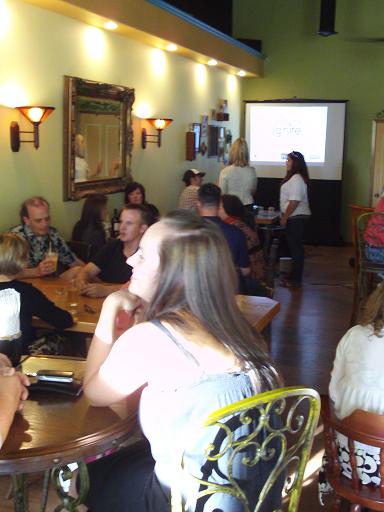
IgniteSD #2 Lights up Madison Main Street

This one's for you, Officer.... I hope it was another quiet night shift.

Hey, what was all that traffic on Main Street...

...on a sunny Tuesday night...

...making it hard to get to the counter at the coffee house?

Oh, just a bunch of people coming out to hear some visual aid speeches...

...at the best darn semi-self-organizing intellectual entertainment in the state!

IgniteSD #2 packed Mochavino here in Madison last night. Fifty-some people squeezed in, folks ranging in age from my own Divine Miss K (still in the single-digits) to my octogenarian neighbor and comrade Gerry Lange. People came from at least five counties (and some new friends, by more complicated life journeys, from Minnesota and New Hampshire!) for coffee, wine, conversation, and enlightenment.

IgniteSD's second program was filled with the Unexpected™:
  1. Jon Hunter spoke of his passion for sailing (ah ha! that Madison logo does speak to us!). I learned that sails work by Bernoulli's principle: it's not push, but sideways lift!
  2. Megan Nelson explained why she likes running marathons better than selling insurance.
  3. Heather Mangan told us how whittling your life down to two suitcases helps you see what matters (I prefer one frame pack myself—right, Toby?—but the idea stands).
  4. Chris Francis touted the upcoming first-in-the-nation White Night arts event, happening right here in Madison July 1.
  5. Joe Bartmann discussed the joys of worm ranching and compost tea... and offered free livestock!
  6. Kent Thompson shared bits of his experiences from eleven years of medical mission trips to Tanzania. He got back from his latest trip hardly 24 hours before speaking at IgniteSD #2.
  7. Jael Thorpe extolled the virtue of being one's own boss, running for office, and not wasting time waiting for things to happen.
I'd have snapped pix of the speakers, but I was busy emcee-ing... and enjoying every presentation!

I rhapsodized about the community-building value of Ignite events after the first IgniteSD in Brookings last month. I feel the same way tonight. At Ignite, anybody who wants to speak can speak. People want to come and listen, not because the speakers are famous or rich or powerful, but because they are us. Ignite brings South Dakotans together to say things that matter. We need more of that...

...and we'll get more! Organizer John Meyer says we can expect IgniteSD #3 to take place in Sioux Falls in June! He said he was thinking holding it at an outside venue... but last night's 40-mile-per-hour gusts reminded him that keeping this event indoors is just fine. Stay tuned to IgniteSD.com (and this very blog) for updates!

----------------------
Update: IgniteSD #2 gets mention on KJAM as well.

Wednesday, May 5, 2010

IgniteSD #2 in Madison May 25 -- Come Speak!

IgniteSD was a blast in Brookings—it'll be magnificent in Madison!

Organizers have just announced that IgniteSD will hold its second event at our favorite coffee house, Mochavino, right here in downtown Madison on Tuesday, May 25, 7:30 p.m.

To review: Ignite is a social event for folks to get up and tell each other what matters. The topic is wide open: pick something you're passionate about and tell us about it! Maybe it's a new idea you have, a gadget you'd like to build, a project you're working on. Maybe it's a job or a trip or an adventure you had. Maybe it's an amazing experience you think other people need to hear about. If you think it's worth sharing over beverages at the electronic campfire, then the floor is yours!

The format asks that each speaker "enlighten us, but make it quick!" You prepare a five-minute speech and back it with a 20-slide presentation. Each slide displays for 15 seconds, then automatically switches to the next one.

I tried it at IgniteSD #1 and loved it... but it takes a little practice! (Any story worth telling is worth practicing.) If you'd like to take a swing at the mic, give IgniteSD organizers John and Scott Meyer a shout. You can also drop me a line—I'm helping set up the Madison event.

And if you don't want to take the mic, then come take a seat and listen to the most interesting speeches you'll hear on Madison's Main Street this year!

---------------------
Update: note revised start time at 7:30 p.m.

Thursday, April 22, 2010

IgniteSD #1: Building Community Around the Storytelling Fire

Would you believe that on a gorgeous spring evening—60 degrees, no South Dakota wind to blow bikes slantwise, trees blooming, new green everywhere declaring anything possible—62 people came to a diner to watch visual aid speeches?

The inaugural IgniteSD event at Cottonwood Bistro in Brookings last night had nine speakers on the schedule. I drove up after supper, practicing madly behind the wheel, visualizing the merciless flip of my slides, and wondering if I was overdoing it. Nine speakers... we might outnumber the people who come to listen. There were no famous names on the program—heck, what program? Just a start time and a list of speakers. I could easily envision getting all worked up just to talk to my eight fellow speakers, Scott and John Meyer's mom, and a few confused late diners who just wanted a sandwich and a beer.

Mrs. Meyer was there. So was a pretty big crowd. A young crowd. People who wanted to learn something new. People who wanted to try something new. People who wanted to be enriched by the ideas and experiences of their neighbors.

And more than a few people who, like me, define neighbor as pretty much anyone living in South Dakota.

Yes, I had fun giving my speech (even as Megan's Mac ate my fonts!). Yes, I will occasionally brag that, if nothing can go down in history as the first person to give an Ignite talk in South Dakota. (Why yes, I think I will add that to my résumé. ;-) )

But even if I hadn't taken my turn at the mic, I'd have still come away charged up by the Ignite experience. Without any coordination of topics, nine neighbors from Brookings, Sioux Falls, and Madison put together an MTV-Chautauqua, a whirlwind of speeches and images about their passions. Blogging, astronomy, wedding officiation, journalists and interviews, family stories, tea, customer service, Norway, and intuition. We gathered like a tribal council around an electronic fire stoked with our visions and metaphors, taking in stories declared worth sharing not by some chief or shaman, but by our equals, by people just like us. We told each other, even the good folks not on the roster, Your story matters. Tell it. With passion.

I suspect more people will come do exactly that at IgniteSD #2. Less than 24 hours later, I'm still dialing down the adrenaline from #1, and folks in Vermillion, Sioux Falls, and Madison are already angling to host #2 (and I'm not the only Madison angler).

Ignite talks are a great way to build community. We see in each other's eyes not just good ideas and valuable experiences, but a passion behind them. We see we don't have to be quiet Midwesterners and aw-shucks-t'ain't-nothin' our interests. We see our neighbors doing interesting things, and we inspire each other to do more, to live more. We learn, as John Taylor Gatto might say, that good ideas and passions are like dirt: they're everywhere, right here, in our neighborhood. We just have to get up and share them with our neighbors, our fellow South Dakotans... who really are this darned cool.

---------------------------------------
Update 2010.04.23 07:50 CDT: The Displaced Plainsman reminds us Ignite talks beat the snot out of prom: less planning, more enriching. Ignite talks may also intersect with Richard Florida's thinking... discuss!

Heather had fun, too. :-)

IgniteSD: Next Stop Madison?

My brain's still spinning (quite happily) from the energy and excitement of last night's inaugural IgniteSD event in Brookings. Loved it, loved it, loved it! Kudos to all my fellow speakers!

I'm still sorting out my observations—tougher to do when you're in the soup! For first review, check out journalist Joe O'Sullivan's excellent account at ThePostSD.com. I learned that I gave an "upbeat rant" (nice to see rant used positively!)... and that I have an astronomy-loving "schizophrenic alter ego" majoring in global studies at SDSU. Go figure! :-)

Stay tuned: I'll wax philosophical and rhapsodize metaphorical about South Dakota and creative cultural development later!

In the meantime, the IgniteSD planners are eager to host another IgniteSD event to bring out the passion and genius bubbling up all across our state. Anyone in Madison interested in hosting IgniteSD #2? Check out the How To on Ignite talks, particularly the Location info. Ignite talks a have got to have a bar—right up Madison's alley, right? ;-) Then let's fire one up here in Madison!

Wednesday, April 21, 2010

IgniteSD Tonight in Brookings!

IgniteSD launches tonight in Brookings! Come hear some of South Dakota's sharpest up-and-comers talk about what lights their fuse. I'll be there, too, giving a talk on (what else?) blogging.

Mr. Dahle offers a good summary of what the event is about: speakers boiling down their great ideas into five minutes of fast enlightenment and fun slides. More thoughtful than Twitter, more compressed than a classroom lecture... it's a challenging format (believe me—I'm practicing right now!), but it promises an action-packed evening for your brain... with real live people!

Plus, it's free (though I'm sure our nice hosts at Cottonwood Bistro won't mind if you buy a snack while you're there). So come to Cottonwood Bistro, Brickwood Plaza in Brookings, tonight, 8:00 to 9:30. Bring questions, not tomatoes. ;-) We'll have coffee, we'll talk.. make it a big whoop!

Friday, March 12, 2010

Health Care Reform: "Did You Wash Your Hands?"

A Friday gift for my conservative readers: I'll advocate health care reform that has nothing to do with big government and everything to do with personal responsibility. If you want to drive down health care costs and reduce hospital infections and deaths, do one simple thing: be annoying. When you go to the hospital, ask any doctor, nurse, or anyone else who tries to touch you, "Did you wash your hands?"

Asking a simple question like that challenges the standard hierarchy of of medical decision-making where the doctor knows best. As Dr. Peter J. Provonost of Johns Hopkins Hospital tells the New York Times, challenging that hierarchy is one of the reforms health care needs. He tells Claudia Dreifus about his efforts to get doctors to follow simple checklists to reduce medical errors:

As at many hospitals, we had dysfunctional teamwork because of an exceedingly hierarchal culture. When confrontations occurred, the problem was rarely framed in terms of what was best for the patient. It was: “I’m right. I’m more senior than you. Don’t tell me what to do.” With... infection after a catheter insertion, our rates were sky high: about 11 per 1,000, which, at the time, put us in the worst 10 percent in the country.

Catheters are inserted into the veins near the heart before major surgery, in the I.C.U., for chemotherapy and for dialysis. The C.D.C. estimates that 31,000 people a year die from bloodstream infections contracted at hospitals this way. So I thought, “This can be stopped. Hospital infections aren’t like a disease there’s no cure for.” I thought, “Let’s try a checklist that standardizes what clinicians do before catheterization.” It seemed to me that if you looked for the most important safety measures and found some way to make them routine, it could change the picture.The checklist we developed was simple: wash your hands, clean your skin with chlorhexidine, try to avoid placing catheters in the groin, if you can, cover the patient and yourself while inserting the catheter, keep a sterile field, and ask yourself every day if the benefits of catheterization exceed the risks.

Q. Wash your hands? Don't doctors automatically do that?

A. National estimates are that we wash our hands 30 to 40 percent of the time. Hospitals working on improving their safety records are up to 70 percent. Still, that means that 30 percent of the time, people are not doing it [Dr. Peter J. Provonost, interview with Claudia Dreifus, "Doctor Leads Quest for Safer Ways to Care for Patients," New York Times, 2010.03.08].

A single-payer system will also save money and save lives. But while we wait for Stephanie Herseth Sandlin to develop a case of Kucinich courage, we can do some small do-it-ourselves reforms which challenge the prevailing hierarchical hospital culture and prevent unnecessary expense, sickness, and death.

---------------------------
Bonus reading: You might also want to ask your doctor if you really, really need that colonoscopy. (Now he tells me, says Mr. Epp.)

Tuesday, March 2, 2010

SDPB Faces Budget Cuts? Let's Hear from the Office

[Warning: Heavily redacted, due to a friend's request and the apparent absence of First Amendment rights for state employees.]

Last night Jim Clark celebrated the ninth anniversary of his program, Jazz Nightly, on South Dakota Public Broadcasting. Today I learn from Mr. Epp [edit] that our legislature may rain on Uncle Jimmo's tenth year by only partially funding our statewide public broadcaster.

Why does this matter? [Permit me to describe] SDPB's community-building function best:

When it comes to creating a culture that is uniquely South Dakota, SDPB is it. Commercial radio and TV are just fountains for national content that rarely includes talent from this part of the country. Shows like "No Cover, No Minimum" showcase regional talent on a statewide broadcast network, for free [words I now claim as my own]

Legislators, SDPB is an investment, not an expense. It is the only broadcast source for classical music and jazz and extended news programming. It is one of the few broadcast media outlets that brings any focus to South Dakota artists and events. And lately, Paul Guggenheimer's noon program been bringing us the best conversations on the dial.

Yes, the Legislature faces a hard task in balancing the state budget. But let's not let them make SDPB an easy target. Let's keep an eye on that budget process and protect one of South Dakota's finest educational and cultural resources.

--------------------
To learn more, go to savesdpb.org.

See also David Montgomery's investigation of the possible cuts at the Capitol.

Monday, February 22, 2010

Madison Daily Leader Shuns Homosexuals, Even in Death

The Madison Daily Leader runs an obituary for MHS alumnus William Charles Elliot Clarke:

He was born on Feb. 23, 1962, at Lennox to Erhard and Lily Borchardt. He grew up in Madison and graduated from Madison High School. He attended the University of Arizona at Flagstaff and was a music and art major. In 2004, he received his nursing license.

He was preceded in death by his parents; a sister, Sharon Lampson; and a brother, Ray "Butch" Borchardt.

Hmm... no spouse or family to survive him? I have to turn to a paid obituary, lower left, page 2 of Friday's print edition, to learn about Mr. Clarke's significant other:

He was a true friend, caring brother, and loving partner to his life partner Bob Schmitz. Bill and Bob were together for 21 years and through all times their deep love and support for each other was apparent.

So Mr. Clarke had a partner of 21 years, and our local newspaper chooses not to mention him in the formal obit?

This is not the first time Madison's newspaper has chosen to omit mention of a gay partner from an obituary. Consider this 2003 obit for Douglas Richard Larson (emphasis mine):

He was a member of the Kiwanis, Elks, Lions Club, Toastmasters, Madison Chamber of Commerce and the Area Development Board.

Survivors include his wife Victoria of Brookings; two sons, Sean and Kenneth, both of Brookings; his father, Richard of Brookings; a brother, Brent of San Francisco, Calif.; a sister, Linnea (David) Bradbury of Plano, Texas; two nieces and a nephew.

He was preceded in death by a grandfather and a grandmother.

Now view the obit from Rude's Funeral Home:

He was a member of the Kiwanis, Elks, Lions Club, Toastmasters, Madison Chamber of Commerce and the Area Development Board. He enjoyed riding motorcycle, sailing, photography, computers, writing and philosophy. He was also an ordained minister. He especially enjoyed spending time with his family. Doug is survived by his wife Victoria of Brookings; two sons Sean and Kenneth both of Brookings; one brother Brent Larson and his partner Joseph Driste of San Francisco, CA; one sister Linnea Bradbury (David) of Plano, TX; his father Richard Larson of Brookings; nieces Andrea Lovoll and Stephanie Simons and nephew Nick Simons. He was preceded in death by his grandfather Ferman Feeney and grandmother Pearl Larson.

The MDL obit mentions the husband of a sister, but not the partner of a brother.

As I've said before, the Madison Daily Leader is a private business. Publisher Jon Hunter can choose to print or not print whatever he wants (and he usually does, regardless of any stated "policy").

But the choices Hunter and his staff make tell us something about our local culture. The Leader will mention fiancées in obituaries. Compare also the coverage of the death last week of MHS alumnus Benjamin Bundy. Along with Bundy's formal obit, Hunter publishes a tribute article that, in Friday's print edition, features a color photo of Bundy "with his long-time girlfriend, Laura Niedert."

Long-time. Bundy was 20. Long-time means what, six years, tops? Clarke shared his life with a man for 21 years, and the Leader won't mention that unless it's paid.

I guess some meaningful relationships are acceptable for news coverage, but some remain unspeakable to our "free" press.

Sunday, January 17, 2010

From Garden Gnomes with Love: "Those Simple Things" by Right Said Fred

File under pop culture archaeology... or "What were we thinking?" A love song by Right Said Fred: "Those Simple Things," 1992:


Remember, these guys came from the culture that won the Cold War.

Tuesday, November 10, 2009

South Dakota: Unhappiest Home on the Prairie?

The Gallup-Healthways Well-Being Index for 2009 is out, and South Dakota Tourism will not be trumpeting the results. According to this survey, we have a lower happiness score than any neighboring state (click image to enlarge):
Now these scores are on a 100-point scale, and the difference between the happiest state (Utah at 69.2) and the lowest (West Virginia at 61.2) is only 8 points. So I suppose you could argue that all those extra taxes they pay over in the People's Democratic Republic of Minnesota aren't buying them much more happiness.

Then again, I could argue that even with all their radical socialism, Minnesotans are still happier than we no-tax, anarcho-capitalist South Dakotans.

The researchers based their ratings on interviews with 350,000 Americans throughout 2008. The respondents rated their "overall evaluation of their lives, emotional health, physical health, healthy behaviors (such as whether a person smokes or exercises), and job satisfaction."

The researchers warn this is all generalization: you can still find Pollyannas and crab apples in every state (though not in the blogosphere; we're all pretty much crab apples here ;-) ). Nonetheless, the researchers did find that states with higher happiness tended to have...
  1. higher GDP per capita
  2. higher median housing values
  3. more educated workers with "super-creative" jobs (ooo, that's me!)
  4. bohemians (you know: us artsy-fartsy types!)
  5. homosexuals
  6. foreigners.
Bohemians, homosexuals, and foreigners... sounds like a recipe for a heck of a party!

Monday, September 28, 2009

Julie & Julia: Manhood, Blogging, and the Modern Psyche

Some grandparental babysitting allowed us a date night last night. We saw Julie & Julia, which has been lingering unloved at Madison's movie house for a week and a half. This is not because it is an unlovable movie. But a conversation with cinema management noted that in general, the local movie audience is the junior high kids. Nearly every other demographic in Madison chooses the bar as its primary out-of-the-house entertainment. And we know how that turns out. Sigh.

No 3300-word review this time (the film is good, but it's not Star Trek ;-) ). But I do want to join Dr. Blanchard and Mr. Rosenthal in praising Julie & Julia. Per the title, it is really two films: one great movie (Julia) with a whole 'nother passable movie (Julie) woven into it.

The great movie is the story of Julia Child and her husband Paul. It is blissful filmmaking, with as much joie de vivre as joie de cuisine. We see two rich characters, Julia and Paul, utterly self-assured and utterly in love. Their setbacks and disappointments never become fodder for emotional crises or meltdowns or marital spats... yet we feel their struggles and occasional sadness all the more poignantly in the shared resolve and unflagging commitment to each other with which Julia and Paul face them.

Much has been and should be said about Meryl Streep's incarnation of Julia Child. As much can be said about Stanley Tucci's great performance as Paul Child. Tucci takes a role that could so easily be phoned in—"Meryl's got the big role; no one's paying attention to anything else on screen"—and inhabits the man and the moment as studiously and confidently as his co-star. Paul Child served his country in the OSS in China during World War II, only to face McCarthyite questioning of his patriotism (and his sexuality) and the concomitant decline of his career. In the midst of such setbacks, Tucci shows a man who maintains his sense of self-worth and his unwavering and very open devotion to a wife whose ambitions and expansive character might have overwhelmed a lesser man. In his portrayal of Paul Child, Tucci offers a primer in manhood, not to mention fine acting.

I vote Oscar for Streep... but only on the condition of an Oscar for Tucci.

The passable movie was the story of Julie, the modern girl who finds meaning and her fifteen minutes of fame by cooking and blogging her way through Julia Child's recipes. I found this strand of the film tolerable, even better than some of the reviews I'd read suggested, until director Nora Ephron gave us the little marital spat where Julie's hubby got sick of Julie's self-absorption (not to mention having to wait so long to eat dinner) and went and slept in his office for a whole night. At that moment, their story seemed so... small.

The Julie strand can't help but pale next to the Julia strand. Julia and Paul, after successful and adventurous careers in espionage, face down sexism and McCarthyism. Julie's public service job is portrayed as an exercise in powerlessness from which she craves escape. Julia bangs out great bulky book drafts with typewriter and carbon paper and struggles with a lazy co-author, skeptical publishers, and the sheer bulk of recipes she wants to share for eight years before her book hits the public eye. Julia taps out daily thoughts, following the template of a book already written, and hits "Publish" to reach the masses effortlessly. Julia and Paul make Julie and her husband (name already forgotten), Julie's blogging (a "gimmick," says NYT's A.O. Scott), and her emotional journey seem trivial.

(Blogging as trivial exercise in narcissism—should I be nervous? ;-) )

Some reviewers have faulted Ephron for trying to shoehorn these two uneven stories into one film... but maybe that was Ephron's intention. Perhaps she wanted that glaring imbalance to shine through. Perhaps we can read Julie & Julia from a "Greatest Generation" perspective. Maybe our grandparents lived bigger lives. They could be sexy without stripping off their shirts (compare the scene where Paul sweeps Julia away for a postprandial coupling with Julie and hubby trundling through the apartment for sex: no skin in the former, but Julie is obligatorily stripped to impractically skimpy bra and panties for public viewing). We complicate our modern lives with unnecessary internal conflict and whining (Paul never whines) when we could be living and loving on a grander scale.

I could quibble with the title—why on earth does the lesser character get top billing?—but even there, I can see intention by the director to highlight and critique our modern generation's egocentrism.

Julie & Julia is a good, conversation-worthy film, deftly capturing and contrasting two generations of Americans. Don't let the unbalanced strands fool you: paralleling the lives of Julia and Paul Child with the lives of two modern somewhat-counterparts does not degrade the greater story. Consider the Julie story a soft undertone, a counterpoint to the overarching symphony that is Julia's life.

---------------------------------------
Tangential Addendum 23:02 CDT: At age 85, Judith Jones, the editor at Knopf who gave Julia Child's book its big break and its title, is still editing. Three years ago, she also got into the cattle business. She now raises a herd of 20 cattle near her summer home in Vermont. Her beef is all grass-fed, which has a flavor, she says, she hadn't experienced since her 20s, in Paris. Her stepdaughter and partner in small-scale ranching, Bronwyn Dunne, sees the importance of growing food locally:

“Supporting a local economy is beneficial to everybody,” she said. It also resonates beyond the quaint trendiness of the farmers’ market: “It may be the future of food security in the world” [Christine Muhlke, "Raising Steaks," New York Times, 2009.09.24].

Saturday, September 26, 2009

There's Carts, and Then There's Carts: Librarians and Shriners in Trojan Days Parade

Dakota State University held its Trojan Days homecoming parade today. Amidst the spectacle: carts...


Madison librarians and friends bust some precision moves with their book carts


...and more carts!


The
El Riad Shrine Sprint Car Unit from Sioux Falls
burns some Trojan Days rubber. Typical driving for Madison, actually.


Of course, Madison put the carts before the horses...


...but shouldn't they have had the skid steers bringing up the rear to clean up?

Thursday, September 17, 2009

Meme of the Week: Calhoun Conservatism

Have you heard of Calhoun conservatism? Google it in quotes, and as of this writing, you get just 980 hits. I didn't hear the phrase until this weekend, from Dr. Peniel Joseph on NPR's All Things Considered. The Tufts history professor sees Rep. Addison Graves "Joe" Wilson's Congressional outburst, the birther movement, the tea parties, and other wingnuttery as part of a pattern in American protest movements that goes back to the pre-Civil War South:

...what we're seeing in a way recalls what people call Calhoun Conservatism for the South Carolina Senator John C. Calhoun who really in the 1830s had his own vision of the way in which American democracy was going to look.

And his vision of American democracy was less expansive than Andrew Jackson. It was less expansive than the more progressive elements in the country. It was a vision that didn't include freedom for African-Americans. It didn't include robust and expansive rights. And when we think about the way in which these modern Calhoun conservatives are using the notion of American democracy, it's really a government that has very, very little control and responsibility over most American citizens.

They're using things like they're talking about the 10th Amendment and nullification. And nullification was used during the period of antebellum slavery, the notion that states have the right to prevent the federal government from impinging on their own autonomy and rights to own slaves. So what's interesting here is that their vision of American society, American democracy actually harkens back to the antebellum period in American history [Dr. Peniel Joseph, interviewed by Guy Raz, "In Health Care Debate, Echoes of History," NPR: All Things Considered, 2009.09.12].

Mike Lux identifies threads of this Calhoun conservatism afoot throughout GOP/right-wing politics in their flirtations with secessionist and nullificationist language (Governor Pawlenty? Are you serious? Fortunately for us, "Minnesota Nice" convinced Pawlenty to back off that one... sort of.)

If Calhoun conservatism is resurgent, perhaps we can blame... Wal-Mart? Harold Meyerson recounts Sam Walton's crass effort to evade federal minimum wage laws, even after a federal court ruling and penalty against his company, by cutting the checks as ordered by the courts, but then telling employees, "I'll fire anyone who cashes the check." Meyerson sees Walton's business "ethics" tying old Dixie with the modern psyche:

As the unionized General Motors was big enough to set the pattern for the employment of nonprofessional Americans in the three decades following World War II, Wal-Mart is now so big it is setting the pattern today. Each created a distinct national buying public for its goods that was far larger than its immediate work force: in GM's case, workers who could afford to buy new cars; in Wal-Mart's, workers who could afford to shop nowhere except Wal-Mart. With Wal-Mart's rise, the same traditional values that underpinned Sam Walton's cheating and threatening of his workers -- contempt for Yankee laws and regulations, and a preference for the authoritarian, low-wage labor system of the South -- have become more the norm than the exception in America's economic life [Harold Meyerson, "In Wal-Mart's Image," The American Prospect, 2009.09.11].

Calhoun conservatism: an old Southern worldview, reinforced by a dominant corporation? The possible connection is intriguing.

Monday, September 14, 2009

Restaurant Notes: Madison's El Vaquero Gets New Furniture

O.K., you're looking at that headline and thinking, "This is news?"

Well, when I walk into the only Mexican restaurant in Madison, South Dakota, and see this, yes, new furniture is news:

El Vaquero's new decor. Click photo for larger image... if this much color won't crash your computer!

When we walked into El Vaquero for supper Saturday night, my aesthetic heart did backflips. Gone are the old rundown Uncle Ed's Café/Second Street Diner 1970s-era booths and tables. El Vaquero now has a completely new decor, an explosion of color that says, "¡Holá! ¡Bienvenidos! Eat and enjoy!"

First two booths you'll see when you walk in the door at El Vaquero.

The new booths, tables, and lamps say quite a bit about the restaurant and the owners. Anyone who has seen my paintings (or my clothes from high school) knows that I love bold, fearless color and lots of it. El Vaquero's new decor is no safe, Midwestern choice. El Vaquero's owners want to be surrounded by vistas, stories, and every color of the rainbow. Some might say it's too busy, with too many clashing colors, but I find the unique images on each booth rich and vibrant... just like life.

The new decor also shouts permanence. For its first couple years, El Vaquero made do with what it inherited from the old diner. It felt like a rental property, a cheap, secondhand space inhabited but not really owned by the inhabitants. This is no cheap, anonymous furniture that could be left behind for the next owner. The new decor, right down to the EL VAQUERO engraved boldly into the booth backs, exults "This place is ours! We're making it! We're staying!"

El Vaquero must be making it: this furniture looks like it cost money. For too many diners and other businesses in Madison and throughout our somewhat impoverished (financially and aesthetically) state, decor is an afterthought: get some plain tables and chairs on discount, tack up some John Green prints, good enough.

El Vaquero's owners are no aesthetic buckaroos. Their new furniture isn't a throwaway decision made on the basis of a fire sale at some mass-production cheapo restaurant supplier. I could be mistaken, but each booth appears to be hand-carved and hand-painted wood, with different scenes on the fronts, backs, and sides. The pieces come from Lacandona in Jalisco, México, showing the owners were willing to pay a premium for authenticity on top of color and craftsmanship.

Detail on El Vaquero chair backs: sweet birds of paradise... and prosperity?

I hope the owners of El Vaquero won't catch heck for not buying their furniture locally the way Madisonites can catch heck for not buying nice American cars at Prostrollo's. Tom Kommes from Montgomery's* was there Saturday night, and when I asked if the store planned to carry any of Lacandona's home line, he sounded skeptical. Of course he would: most Midwesterners would never dare put anything this colorful in their homes or businesses.

And that's precisely why I love the new decor at El Vaquero. This unique and brilliant Mexican furniture immensely improves the restaurant culture of our fair city. Nowhere else in Madison or Lake County can you find anything like this vivid visual dining experience. El Vaquero makes Nicky's, the closest thing in most Madison minds to fine dining, look like a windowless dungeon.

Oh yeah, and the food is darn good. A hundred entrees on the biggest menu in town, most under $10. I took Scott Parsley's recommendation (after he gave me heck for my snarky East River coverage) and had the #62, enchilada with grilled shrimp—total yum! I'd keep eating there even if they just painted the interior beige and put out folding chairs. But when El Vaquero can satiate both my gastronomic and aesthetic appetites, I'm that much more inclined to recommend the place to all my friends.

Ring the dinner bell; El Vaquero is in!

------------------------
*I'd link to Montgomery Furniture, but Google keeps telling me their website may harm my computer. Clark! Call tech support!